Introduction
Hi, I'm cardene, a software engineer and technical writer focused on blockchain and AI.
I've also authored Japanese technical books on specification-driven development with LLMs and decentralized application (DApp) development.

I also build and publish a variety of tools, libraries, and open-source projects.
Overview of Paladin
Paladin is an execution framework that allows multiple assets and business operations to settle atomically on a shared EVM while disclosing transaction details only to the participants who need them.
Each participant's node distributes private data and prepares signatures or proofs. Contracts on the shared ledger ultimately verify the submitted evidence and update the state.
Suppose Bob sells a bond to Sally.
They want to avoid delivering the bond without receiving payment, but they do not want to disclose the price or quantity to everyone who can read the ledger.
They therefore prepare the trade terms, which the parties can read, and the transfers of the bond and payment separately, then combine final settlement into a single transaction.
This simultaneous delivery of an asset and its payment is known as DvP (delivery versus payment).
The original diagrams are retained throughout this article; their labels remain in Japanese.
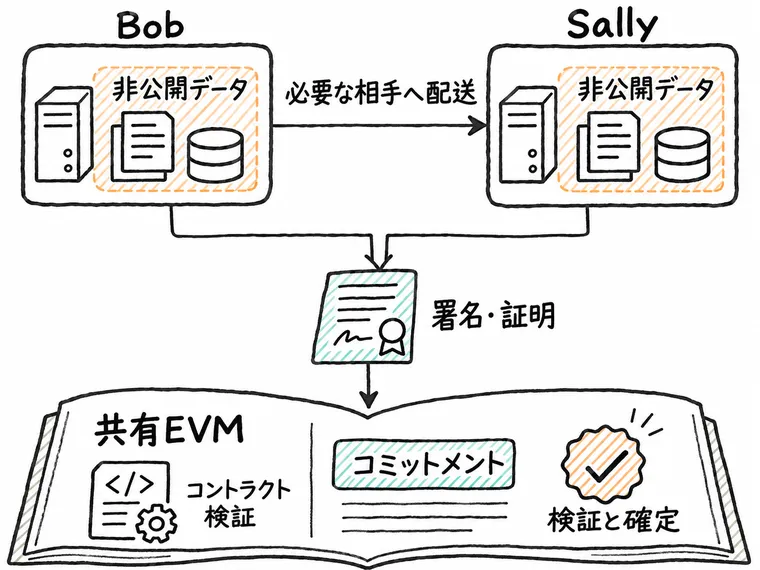
Participant nodes and the shared EVM
Bob's and Sally's nodes construct the transaction using the trade terms and information about their asset holdings.
They distribute data that needs to be disclosed to the other party's node and collect signatures or proofs from the parties responsible for validating it.
Paladin, which operates outside the shared ledger, coordinates these private transactions.
Contracts implementing the various verification methods reside on the shared EVM.
They check the submitted material against the ledger state and finalize updates that satisfy the required conditions.
The shared chain determines transaction ordering and finality.
This architecture does not require an L2 with separate consensus to support private execution in Paladin.
To support different verification methods, Paladin uses implementation units called domains.
For token transfers, Noto relies on a trusted administrator to validate transaction details, whereas Zeto uses zero-knowledge proofs.
Pente runs EVM business contracts among a restricted set of participants.
Because their public contracts reside on the same EVM, they can all be called from a single transaction despite their different internal verification mechanisms.
However, assuming that only hashes are submitted to the shared EVM underestimates the scope of public information. Contract call targets, public inputs, and events are recorded on the ledger; the sender, gas usage, and execution time are also observable. Design the system around the distinction between private transaction details and information visible to ledger readers.
Private data and state storage
To transfer Bob's bonds, his node must be able to retrieve information about his holdings.
The state store in Paladin persists private data in a node-side database.
State schemas define the data structure, and searchable labels allow the node to find states available for transfers.
The shared EVM receives commitments corresponding to that data.
A commitment is a cryptographic value bound to its contents.
Adding a random salt to a state distinguishes records with identical contents and makes it harder to infer their contents by hashing possible amounts one by one.
Permission to read the raw data is distinct from the ability to inspect its commitment on the ledger.
For example, Bob holds a state representing 100 units of a bond and wants to send 60 to Sally.
The original state representing 100 is consumed, and new states representing Sally's 60 and Bob's remaining 40 are created.
This follows the UTXO model: rather than modifying an old record, an unspent output can be consumed only once.
An attempt to finalize another transfer using the same 100 is rejected by the spent-state check on the shared ledger.
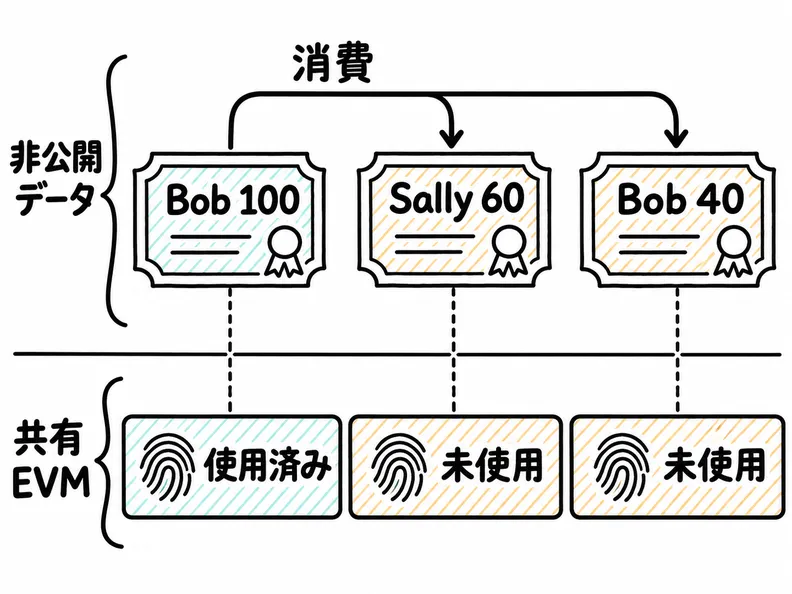
Checking whether a state has been spent is separate from verifying that it was correctly split into 60 and 40.
In Noto, the administrator performs the latter check; in Zeto, a proof for the selected circuit is verified.
There is also a distinction between creating candidate outputs on a node and finalizing those outputs on the shared ledger. The node selects inputs, prepares the transaction, and updates its state by ingesting on-chain finalization events. Because the raw data cannot be recovered from its commitment, distributing and persisting the data for the necessary participants is a prerequisite for subsequent transactions.
Token transfers with Noto and Zeto
When splitting 100 units of a bond into 60 and 40, the choice of who verifies ownership and amounts determines whom the token implementation trusts. For an asset whose issuer enforces holding rules, a method that discloses the necessary information to the issuer may be appropriate. Alternatively, a circuit that verifies the transfer conditions can be used to prove those conditions without disclosing the amount.
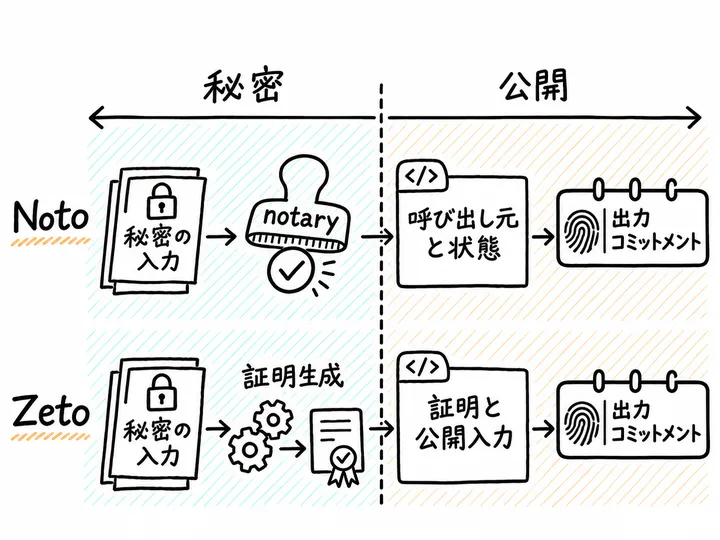
Validation by the Noto administrator
In Noto, the trusted party responsible for validating transfer details is called a notary.
This role is intended for entities such as a bond issuer or an institution administering transfers, and involves checking the requester's signature and holding states.
If Bob sends 60, the notary verifies off-chain that Bob is authorized to use the state and that the transfer amount and change match the input amount.
When the validated transaction is reflected on the shared EVM, the transfer function for transfers and the mint function for issuance are subject to an onlyNotary caller restriction.
The public contract checks whether the caller is the registered notary address.
It also checks that the input states are unspent and that the transaction ID has not been reused before updating the state.
The signature argument supplied here records the signature of the original request.
The notary is responsible for validating the request signature; the public function records it in an event without interpreting its contents.
The public contract checks the caller and state, while the notary validates the request itself.
The notary can read the transaction data used for validation.
Complying with an issuer's holding rules and concealing transactions from that issuer are distinct requirements.
Which requirement applies determines whether Noto is an appropriate choice.
Basic mode allows configuration of permissions for issuance and burn operations that reduce the issued supply, as well as the use of locks.
There is also a hooks mode that passes custom business conditions to private processing in Pente, but it does not simply add those conditions on top of the basic-mode restrictions.
Implementations using hooks must also enforce who is authorized to issue or burn tokens in their own business logic.
Zero-knowledge proofs in Zeto
Zeto is a family of token implementations that use zero-knowledge proofs.
The spender generates a proof from information such as their private key and the state being spent, then submits the proof and public inputs to a verifier on the shared EVM.
By proving that the relations defined by the circuit hold, the spender can demonstrate authorized spending of owned states and conservation of amounts without revealing the secret amounts themselves to the public verifier.
When Bob's state is used to create recipient and change states, Paladin likewise selects available inputs, generates a proof, and ingests the finalized outputs.
This process prevents an old state from being spent twice.
The method used to track spent states varies between token types.
For example, a nullifier is a value indicating that a secret state has been used; it helps detect attempts to reuse that state.
Zeto includes types that use a nullifier and types that manage state differently.
How much of the connection between inputs and outputs is concealed, how encrypted data is delivered, and what is disclosed to auditors also depend on the type.
Selecting Zeto therefore does not necessarily conceal every amount, participant, and transaction history uniformly.
Check the token type being deployed, its circuit, and the verification key corresponding to that circuit.
The procedure for generating proving keys is also a security prerequisite, so keys generated for testing should not be confused with a trusted production setup.
Private EVM execution with Pente
In addition to transferring tokens correctly, a transaction may need to satisfy the price and delivery conditions agreed upon by Bob and Sally.
Pente executes EVM business logic using data shared among a restricted set of participants.
It can connect the results of that processing to token transfers while limiting who can read the trade terms.
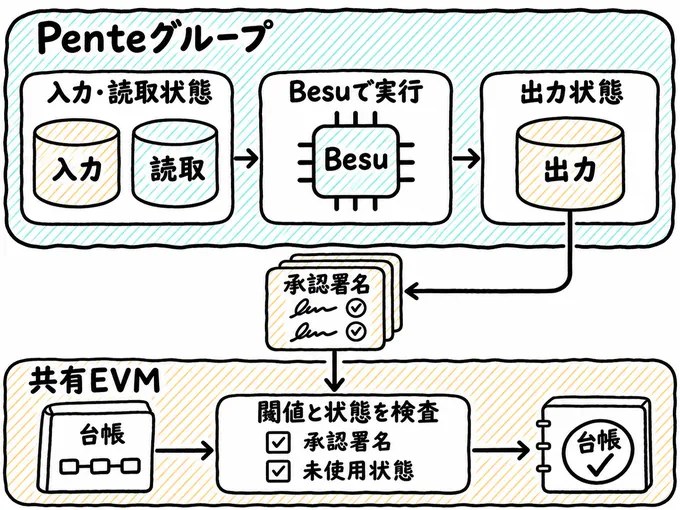
Privacy group execution
Bob and Sally define the scope within which they share business terms as a privacy group. Group members share private contract data and state. A group contract on the shared EVM ties the state transitions to the configured endorsement rules. The ability to read the ledger does not automatically grant access to the group's private data.
When processing a group transaction, Pente retrieves the required account states and executes the code using the EVM implementation in Besu.
It loads the required states into a temporary execution environment and extracts output states after execution, rather than maintaining a separate chain that continuously produces blocks.
These account states also follow the earlier UTXO model: old states are consumed and new ones are created.
Pente calls this account state model C-UTXO.
In addition to states being modified, the transition checks include states that were merely referenced during processing, treating them as read states.
If a referenced state is consumed after endorsement, the update must not be finalized under the original conditions.
Endorsement of state transitions
Endorsers within the group validate the business operation using private inputs and account states, then sign the corresponding state transition. The endorsement covers input, read, and output states, as well as calls to external contracts. This binds the result of checking the price conditions to the state updates that will be finalized.
The contract on the shared EVM counts distinct signatures from configured endorsers and checks whether the required threshold has been reached. It also verifies that the inputs are unspent and that the read states are valid before performing the update. Whether all members must sign depends on the group's configured threshold.
Public verification checks the signatures and consistency of the states. It does not disclose the trade price and re-execute the private EVM calculation, so the correctness of the business computation still depends on trusting the endorsers' validation. The public contract alone offers no guarantee against an invalid result signed by the required number of endorsers.
Execution authority can also be approved in advance so that another contract can execute the operation later.
The approveTransition function associates a particular transition hash with an address authorized to execute that transition.
At execution time, the transitionWithApproval function checks whether the caller matches the approved address.
This approval separates the validation of business conditions from the timing of final execution.
Atomic settlement of the bond and payment
Suppose the bond transferred from Bob to Sally is represented by Noto, the payment from Sally to Bob by Zeto, and the trade terms by Pente.
Each domain uses a different method to verify correctness, but the contracts responsible for final state updates reside on the same shared EVM.
Once all operations are prepared, an execution contract calls them together.
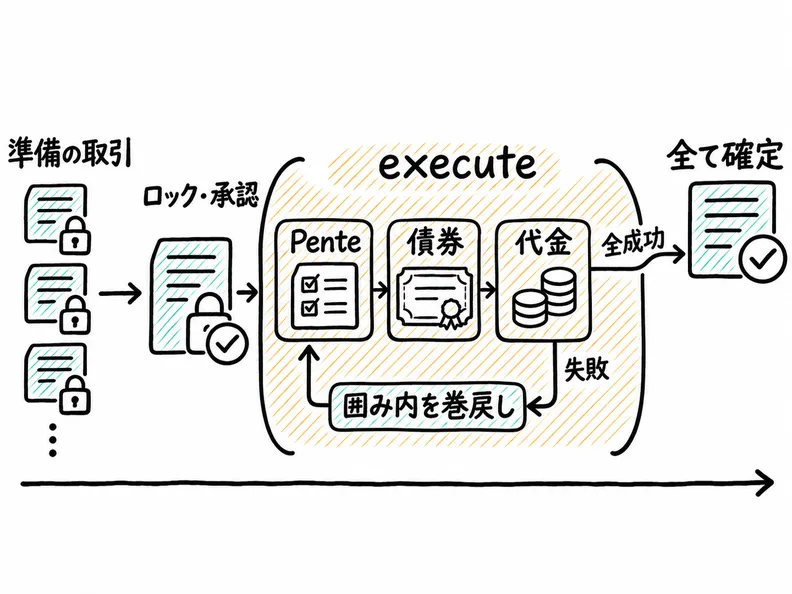
Preparation and approval
Bob and Sally first agree on the trade terms and select the bond and payment states to be transferred.
On the Pente side, they collect the endorsements required for the business operation's result; on the token side, they prepare transfer validations or proofs.
At this stage, track the material prepared within the nodes separately from locks and approvals recorded on the shared EVM.
Once the execution contract's address is known, prepare the required operations so that they can be called from that address. For example, lock the token states to be used and delegate authority to execute an operation with specified inputs and outputs. When locks or delegations are finalized in separate transactions, the original assets' availability changes even before they are transferred to the final recipients. Treating this period as idle time during which nothing has happened can cause you to overlook states that must later be recovered.
The example in which Bob and Sally place their trade agreement in Pente is based on the official conceptual explanation of cross-domain interoperability.
The executable swap tutorial, by contrast, exchanges 100 units of a Noto asset for 10 units of Zeto payment and uses Pente for issuer-side records.
The two examples assign different roles to Pente; they do not describe the same sample code.
The tutorial's older lock API and the v1.0.0 implementation also differ in the functions used to create locks and delegate execution authority.
Execution in a single transaction
Once all operations are ready to execute, the execution contract calls the Pente state transition and both token operations.
The reference implementation's Atom contract stores a sequence of target addresses and call data, then invokes them in order through its execute function.
If any invoked operation fails, it propagates the error to its caller, causing the entire EVM transaction containing execute to revert.
For example, if the payment-side verification fails after the bond transfer has been processed, the bond update within the same transaction is also rolled back. Only when every call succeeds are the bond and payment updates recorded as a single transaction. This all-or-nothing behavior prevents either transfer from finalizing on its own.
To use this property, execute all operations within the same EVM transaction and propagate failures to the outer call. The guarantee does not extend to rolling back transfers independently finalized on different chains. Even after execution succeeds, balance displays should reflect the updates only after chain finality and event ingestion by the relevant nodes.
Failed transactions and lock recovery
Even if the final execute fails, locks and approvals created by earlier transactions remain.
Only updates within the failed EVM transaction are rolled back; previously finalized preparation steps are not.
If the prepared states remain usable, correct the cause and retry. If the trade is abandoned, execute the lock's cancellation path.
In v1.0.0, Noto manages authority to invoke public lock functions through an address called the spender.
The createLock function is called by the notary and records that notary address as both the lock's owner and its initial spender.
This owner field does not represent Bob himself as the bondholder.
Distinguish the asset holder from the address whose calling authority the public contract checks.
A lock can be configured with commitments that bind the intended spend and cancellation operations.
The spendCommitment corresponds to the spending conditions, and the cancelCommitment corresponds to the cancellation conditions.
Both bind the following values of the operation to be executed.
| Value | Condition specified |
|---|---|
| Transaction ID | The transaction identity under which the operation is executed |
| Inputs | Which locked states are consumed |
| Outputs | Which new unspent states are created |
| Data | Additional data attached to the operation |
After configuring both commitments, the current spender can call the delegateLock function to transfer execution authority to another address.
After delegation, the spendLock and cancelLock functions check whether the caller is the current spender and whether the specified operation matches the commitment.
To support cancellation of the trade, the delegate must therefore be able to call the cancellation operation as well as the spending operation.
Bob or a previous executor cannot necessarily cancel the lock unconditionally after delegation.
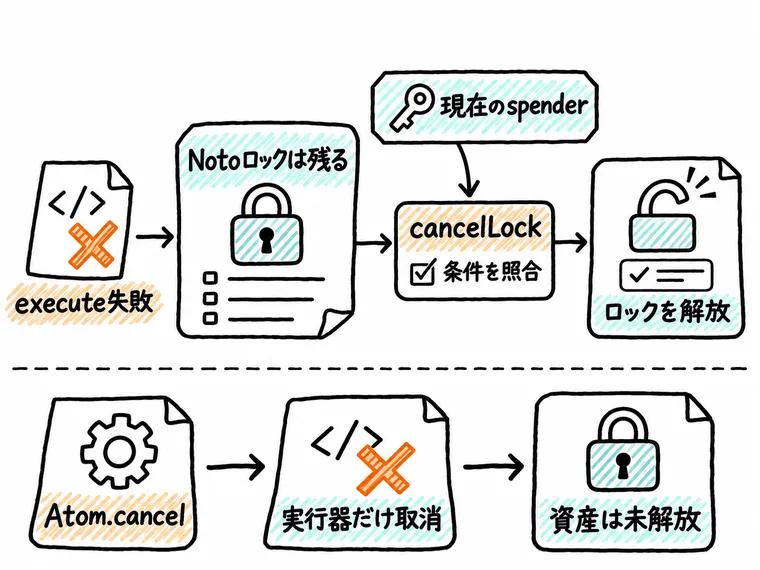
The reference Atom implementation also has a cancel function, but it changes only the executor's state from Pending to Cancelled.
Anyone can call it, but it does not automatically invoke the Noto cancelLock function or return assets.
Cancelling the executor alone does not release the assets, and if the necessary cancellation operation cannot be called from that executor, the lock remains.
A production executor must be designed both around who may cancel it and how delegated locks are released.
Public information and operational requirements
Bob and Sally can share business terms and disclose the information required to validate a transfer to the notary without providing the same details to every ledger reader.
However, where each participant's data and the public records are stored determines both the scope of visibility and what is required for recovery.
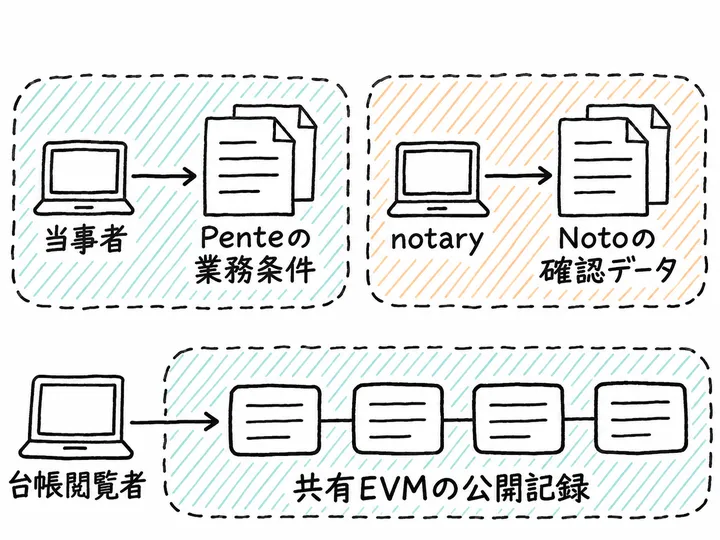
Disclosure and storage boundaries
Members of a Pente group can read the business terms and states disclosed to that group.
A Noto notary can read the transfer data it validates.
The amounts and transaction histories that Zeto can conceal, and the scope of disclosures to auditors, depend on the selected type and configuration.
Even within the same DvP transaction, the recipients of disclosures need not be identical.
Readers of the shared EVM can inspect public inputs, contract calls, and events. If several contracts are called from the same executor in a single transaction, they can also observe that those calls were executed together. Cryptographic concealment of amounts does not guarantee concealment of public calls or their execution times.
Whether the base chain is a public or permissioned network determines who can read its ledger. Configure who receives private data separately from those ledger-reading permissions. Also manage permission to hold data separately from authority to sign operations that spend assets.
Key and data availability
Permission to call the Paladin API from an application is separate from on-chain signature and spender checks.
The RPC authorizer is an optional mechanism for authenticating and authorizing incoming API requests.
Enabling private transactions does not automatically protect every API, so define which APIs are exposed and which parties can request signatures.
Signing keys can be managed in conjunction with external key vaults or signing modules. However, whether key material must be loaded into memory or signing can be performed entirely inside the vault depends on whether that vault supports the required cryptographic operations and proof generation. Configuring an external vault alone does not necessarily isolate all secrets used for proof generation from the node.
Private data and keys are also distinct recovery targets. Even if the keys survive, losing the raw data for required input states prevents further processing; conversely, retaining the data without the necessary keys prevents signing or proof generation. Verify state distribution to participants, persistence, database backups, and key backups separately.
Transactions that require particular endorsers or a notary cannot progress while those parties are unresponsive.
Proof generation and data delivery take time, and execution and finality on the shared chain must ultimately be awaited.
Actual performance should be measured across this entire process with comparable domain and participant configurations.
A guarantee of all-or-nothing execution is distinct from a guarantee that a transaction will complete within a specified time even if a participant is unresponsive.
Conclusion
Paladin coordinates private data delivery and private execution among participants, combining domain-specific verification with atomic settlement on a shared EVM.
The choice of Noto validators, Zeto circuits, and Pente endorsement thresholds changes what is disclosed to whom and whose judgment is trusted.
Designing for both completion and cancellation requires tracing not only the final atomic exchange of bond and payment but also the preceding locks and delegations and their release after a failure.
Official documentation covering the architecture of Paladin and its domains:
The public contracts and reference implementation for the version discussed here are available under the official repository's v1.0.0 tag.

Public implementations of Zeto token types and proof circuits: