Introduction
Hi, I'm cardene, a software engineer and technical writer focused on blockchain and AI.
I've also authored Japanese technical books on specification-driven development with LLMs and decentralized application (DApp) development.

I also build and publish a variety of tools, libraries, and open-source projects.
This article examines EIP-6800, which proposes freezing the existing Patricia tree and introducing a Verkle tree alongside it. The goal is to reduce state proofs from several kilobytes to a few hundred bytes, enabling efficient synchronization for stateless clients. The article describes the proposal as covered in the original article published on July 3, 2025.
This article translates, summarizes, and expands on the specification linked below.

I also cover a variety of other EIPs.

Overview
EIP-6800 proposes introducing a Verkle tree alongside the existing hexary Patricia tree used to manage Ethereum state. After the hard fork, the existing Patricia tree becomes read-only, and all state updates are recorded in the Verkle tree. Copies of all accounts and storage entries accessed during transaction execution are also retained in the Verkle tree. Eventually, it becomes possible to retire the Patricia tree and manage execution state entirely with the Verkle tree.
Hexary Patricia tree
A hexary Patricia tree is a tree structure used to manage Ethereum state. It stores state data efficiently by traversing keys along hexadecimal branches (hexary) and combining this with path compression (Patricia). Each node has up to 16 child branches, and hashes are used to verify node integrity when storing or updating data. Path compression combines consecutive sections with only one possible path into a single extension node, reducing the depth of the tree. This balances storage efficiency with lookup performance.
On the Ethereum blockchain, account information and storage data are stored in this Patricia tree, while the block header contains only the root hash. During transaction execution, Merkle proofs are generated for the required accounts or storage entries, and their validity is verified by computing hashes between nodes.
Verkle tree
A Verkle tree is a data structure proposed to address the growth in proof sizes associated with Patricia trees. It uses Pedersen commitments to link nodes. Where a hexary Patricia tree requires a Merkle proof averaging several kilobytes, a Verkle tree reduces that average to approximately 200 bytes, significantly reducing network load.
Each Verkle tree node uses a predefined set of points known as Pedersen basis vectors and corresponding numerical values (scalars). The calculation starts at the point at infinity, multiplies each basis vector by the corresponding child node's scalar value, and adds the results together. The resulting point is the node's commitment point.
A 32-byte key is divided into a stem consisting of the first 31 bytes and a suffix consisting of the final byte. Values sharing the same stem are grouped together, forming a subtree with leaves corresponding to the 256 possible suffixes. This divides the overall tree into more manageable units.
To distinguish a leaf whose value really is zero from an empty position with no value set, is added to the lower half of the value (16 bytes). When reading the tree later, it is therefore possible to distinguish a stored zero from the absence of a value.
First, the subtree for each stem is combined and converted to a single scalar value. The stems are then combined using Pedersen commitments. Repeating this process recursively throughout the tree produces a single root commitment point. The root uniquely represents Ethereum state and can reduce proof sizes from several kilobytes to just a few hundred bytes compared with the Patricia tree.
Motivation
A major obstacle to supporting stateless clients on Ethereum is the size of witness data. With the current Patricia tree, generating a Merkle proof for an account takes about 3 kB on average, and the worst case can be three times that size. Assuming up to approximately 6,000 account accesses in an Ethereum block, the witness size per block can reach approximately 18 MB. Reliably transmitting this much data over a peer-to-peer network within a 12-second block time is impractical.
A Verkle tree, by contrast, can reduce the average proof size per account to about 200 B. This substantial reduction enables stateless clients to exchange the necessary witness data efficiently and reliably over the network, creating opportunities to further improve Ethereum's scalability and decentralization.
Specification
Verkle tree
A Verkle tree is a data structure that represents state by building a hierarchy of commitments over pairs of fixed-length 32-byte keys and 32-byte values. Using Pedersen commitments rather than a Merkle tree to link nodes significantly reduces proof sizes.
# Bandersnatch curve order
BANDERSNATCH_MODULUS = \
13108968793781547619861935127046491459309155893440570251786403306729687672801
# Bandersnatch Pedersen basis of length 256
PEDERSEN_BASIS = [....]
VERKLE_NODE_WIDTH = len(PEDERSEN_BASIS)

def group_to_scalar_field(point: Point) -> int:
    # Not collision resistant. Not random oracle.
    # Binding for Pedersen commitments.
    assert isinstance(point, Point)
    if point == bandersnatch.Z:
        return 0
    else:
        return point.map_to_base_field() % BANDERSNATCH_MODULUS

def compute_commitment_root(children: Sequence[int]) -> Point:
    o = bandersnatch.Z
    for generator, child in zip(PEDERSEN_BASIS, children):
        o = bandersnatch.add(o, bandersnatch.mul(generator, child))
    return o

def extension_and_suffix_tree(stem: bytes31, values: Dict[byte, bytes32]) -> int:
    sub_leaves = [0] * 512
    for suffix, value in values.items():
        sub_leaves[2 * suffix] = int.from_bytes(value[:16], 'little') + 2**128
        sub_leaves[2 * suffix + 1] = int.from_bytes(value[16:], 'little')
    C1 = compute_commitment_root(sub_leaves[:256])
    C2 = compute_commitment_root(sub_leaves[256:])
    return compute_commitment_root([1, # Extension marker
                                    int.from_bytes(stem, "little"),
                                    group_to_scalar_field(C1),
                                    group_to_scalar_field(C2)] +
                                    [0] * 252)

def compute_main_tree_root(data: Dict[bytes32, int],
                           prefix: bytes) -> int:
    # Empty subtree: 0
    if len(data) == 0:
        return 0
    elif len(data) == 1:
        return list(data.values())[0]
    else:
        sub_commitments = [
            compute_main_tree_root({
                    key: value for key, value in data.items() if
                    key[:len(prefix) + 1] == prefix + bytes([i])
                }, prefix + bytes([i]))
            for i in range(VERKLE_NODE_WIDTH)
        ]
        return group_to_scalar_field(compute_commitment_root(sub_commitments))

def compute_verkle_root(data: Dict[bytes32, bytes32]) -> Point:
    stems = set(key[:-1] for key in data.keys())
    data_as_stems = {}
    for stem in stems:
        commitment_data = Dict[byte, bytes32]()
        for i in range(VERKLE_NODE_WIDTH):
            if stem + bytes([i]) in data:
                commitment_data[i] = data[stem + bytes([i])]
        data_as_stems[stem] = extension_and_suffix_tree(stem, commitment_data)
    sub_commitments = [
        compute_main_tree_root({
                key: value for key, value in data.items() if
                key[0] == i
            }, bytes([i]))
        for i in range(VERKLE_NODE_WIDTH)
    ]
    return compute_commitment_root(sub_commitments)
Computing node commitments
Each node is associated with a predefined Pedersen basis whose length equals the node width, along with a sequence of scalar values representing its children.
The compute_commitment_root function starts at the point at infinity (the zero point), multiplies each basis element by the corresponding scalar, and adds the resulting points to obtain the commitment point for the entire node.
Constructing extension and suffix trees
At the leaf level, the final byte of a key is treated as the suffix. Values sharing the same stem (the first 31 bytes of the key) are grouped and placed into 256 sub-leaves. If a value exists, its lower and upper 16 bytes are converted to integers separately. Adding to the lower half ensures that a zero value can be distinguished from an empty position. Commitments are then computed separately for the first and second groups of 256 elements. These commitments are combined with the stem information and extension marker in another commitment, representing the stem's subtree as a single scalar value.
Computing the main tree root
After collecting all stems, the main tree recursively extracts subsets according to the leading bytes (prefix) of their keys. It returns 0 for an empty subset, the value itself for a single element, or a scalar derived from a Pedersen commitment for multiple elements. This is repeated across the node width (normally 256 times). Committing to the resulting child commitment sequence produces the top-level commitment point.
Computing the complete Verkle root
Finally, all subcommitments are passed to compute_commitment_root, which combines them with the Pedersen basis to obtain a single root commitment point (of type Point).
This value uniquely represents the state of the entire Verkle tree and serves as the basis for subsequent verification and synchronization.
Distinguishing zero values from empty positions
Unlike the existing Patricia tree, the Verkle tree explicitly distinguishes a value equal to zero from a position where no value has been set. When constructing sub-leaves at the leaf layer, adding to the lower half distinguishes empty sub-leaves (with no value present) from locations where zero is deliberately stored. This enables subsequent verification algorithms to operate correctly.
Illustration
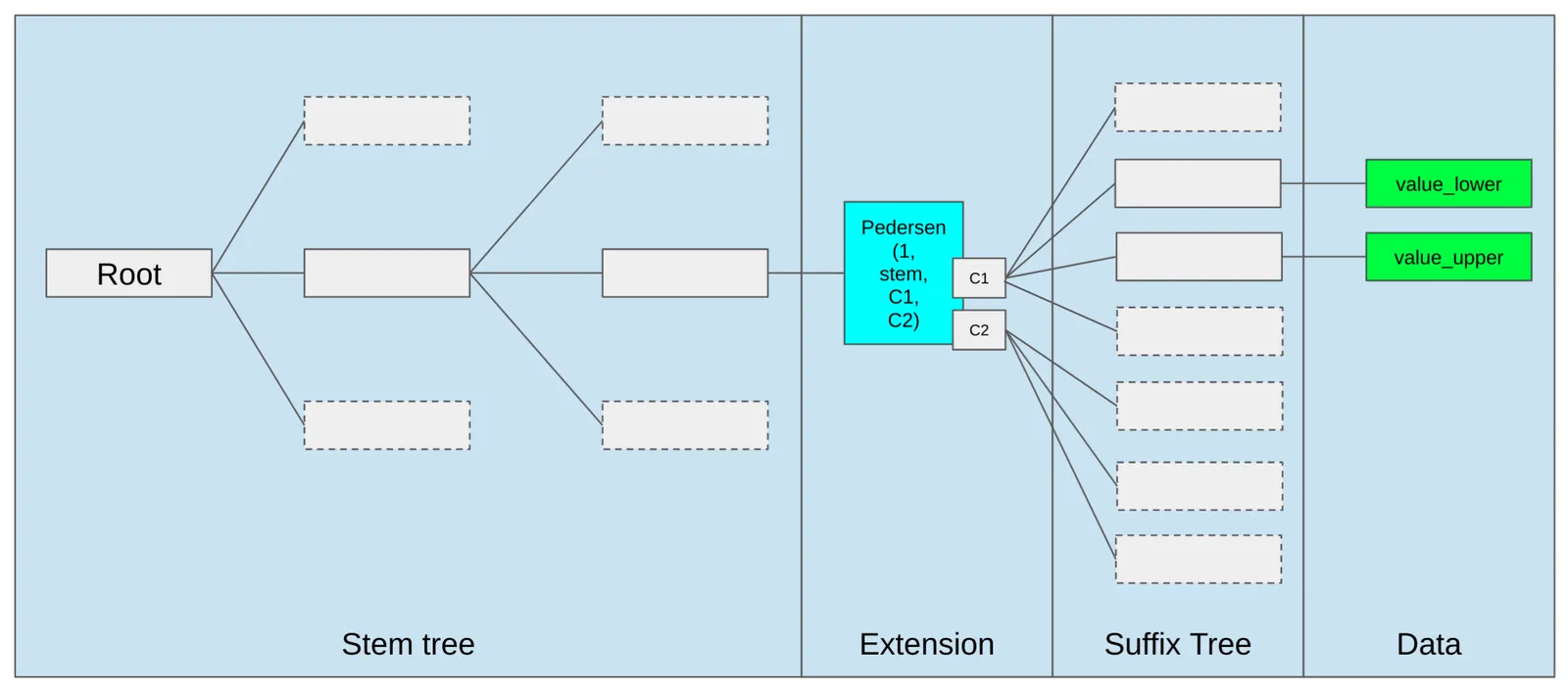
The original illustration is retained; its labels may remain in Japanese.
Embedding data in the tree
Rather than organizing information across multiple layers as in the Patricia tree, a Verkle tree stores everything in a single key-value tree. The following parameters define where different types of information are stored, including basic account data, code hashes, storage, and contract code.
| Parameter | Value |
|---|---|
BASIC_DATA_LEAF_KEY |
|
CODE_HASH_LEAF_KEY |
|
HEADER_STORAGE_OFFSET |
|
CODE_OFFSET |
|
VERKLE_NODE_WIDTH |
|
MAIN_STORAGE_OFFSET |
These values must satisfy VERKLE_NODE_WIDTH > CODE_OFFSET > HEADER_STORAGE_OFFSET, and HEADER_STORAGE_OFFSET must exceed the leaf keys (0 and 1).
In addition, MAIN_STORAGE_OFFSET must be a power of VERKLE_NODE_WIDTH.
Standardizing the address format
When an existing 20-byte address is used as a Verkle tree key, it is extended to 32 bytes by prepending 12 zero bytes.
def old_style_address_to_address32(address: Address) -> Address32:
    return b'\x00' * 12 + address
Storing account header information
Account header information, such as the version, code size, nonce, and balance, is packed at predefined byte offsets and sizes into the value corresponding to BASIC_DATA_LEAF_KEY (value 0).
The version occupies offset 0, the code size occupies bytes 5–7, the nonce occupies bytes 8–15, and the balance occupies bytes 16–31. Setting the version rewrites the entire header.
The code hash is handled similarly using CODE_HASH_LEAF_KEY (value 1).
Storing and chunking code
Contract bytecode is split into 31-byte chunks and stored at positions starting from CODE_OFFSET.
The first byte of each chunk indicates which byte of PUSHDATA the chunk starts with, and the remaining 31 bytes contain the actual code fragment.
def chunkify_code(code: bytes) -> Sequence[bytes32]:
    # 31バイト境界でパディングと分割を行い、PUSHDATA位置を計算して先頭バイトに設定
    …
The original pseudocode comment remains in Japanese. It describes padding and splitting code at 31-byte boundaries, calculating the PUSHDATA position, and setting the first byte accordingly.
Each resulting chunk is mapped to its corresponding tree key using get_tree_key_for_code_chunk.
Storage locations
Smart contract storage slots with offsets below HEADER_STORAGE_OFFSET are placed by adding the offset directly. Other slots are placed by adding their offsets to MAIN_STORAGE_OFFSET.
Related slots within the same node width are committed together, reducing the amount of proof data required when accessing multiple nearby slots at once.
Fork and access events
The specification is introduced through the EIP-7612 hard fork, which makes the existing Patricia tree read-only. Accesses during transaction execution are recorded as access events defined by EIP-4762, allowing reads and writes to the Verkle tree to be tracked.
Additional details
Under EIP-6800, the existing Patricia tree is frozen and a new, empty Verkle tree is introduced in parallel. All state changes resulting from transaction execution and copies of the state accessed are recorded in the Verkle tree, while the Patricia tree remains read-only. This provides a gradual migration path rather than replacing the entire tree structure at once. At a future hard fork, the contents of the frozen Patricia tree can simply be migrated to the Verkle tree off-chain, avoiding the need for clients to transform a large tree in real time.
Key aspects of the Verkle tree design
The Verkle tree is structured as a flat key-value store that works directly with 32-byte keys and values. This simplifies database operations, caching, synchronization, and proof generation and verification code, making future upgrades to other tree structures easier. Distributing state evenly across the tree also makes it more resistant to attacks that concentrate an extreme amount of data in particular storage areas and improves state synchronization efficiency. Account headers and code are stored in the same structure, making it easier to add or extend features.
Revised gas costs
Gas costs for reading and writing code and storage are revised alongside the transition to Verkle trees. Access to code chunks (31-byte units) is set at approximately 6.25 gas per byte. Branch nodes (the branching portions of a proof) are priced at approximately 13.2 gas per byte, assuming an average of 144 bytes, with approximately 2.5 gas per byte in the worst case. Compared with the period after the Berlin upgrade, accessing a code chunk adds 200 gas per chunk, resulting in an expected average gas increase of 6–12%. Accessing adjacent storage slots within the same node width, on the other hand, becomes substantially cheaper, falling from 2,100 gas for the initial access to 200 gas. In particular, all slots with offsets 0–63 are priced uniformly at 200 gas. This is expected to improve the performance of many existing contracts.
Compatibility
There are two main impacts on backward compatibility. First, the higher gas cost of accessing code chunks may make some applications economically unviable. Increasing the block gas limit when implementing the EIP can mitigate the risk of transactions becoming impossible to execute within a block. Second, changing the tree structure means that proofs of past state generated within the EVM (on-chain Merkle proofs) will no longer work as before. This can be addressed by switching to off-chain proof generation after the Patricia tree is frozen.
Citation
Vitalik Buterin (@vbuterin), Dankrad Feist (@dankrad), Kevaundray Wedderburn (@kevaundray), Guillaume Ballet (@gballet), Piper Merriam (@pipermerriam), Gottfried Herold (@GottfriedHerold), Ignacio Hagopian (@jsign), Tanishq Jasoria (@tanishqjasoria), Gajinder Singh (@g11tech), Danno Ferrin (@shemnon), "EIP-6800: Ethereum state using a unified verkle tree [DRAFT]," Ethereum Improvement Proposals, no. 6800, March 2023. [Online serial]. Available: https://eips.ethereum.org/EIPS/eip-6800.
Conclusion
This article covered EIP-6800, which proposes freezing the existing Patricia tree and introducing a Verkle tree alongside it to reduce state proof sizes from several kilobytes to a few hundred bytes and enable efficient synchronization for stateless clients. I hope this explanation was helpful.
If you have questions, feel free to reach out via direct message on Twitter.
I also publish content on other platforms, which you can find below.


