Introduction
Hi, I'm cardene, a software engineer and technical writer focused on blockchain and AI.
I've also authored Japanese technical books on specification-driven development with LLMs and decentralized application (DApp) development.

I also build and publish a variety of tools, libraries, and open-source projects.
This article explores ERC4337, a proposal for implementing account abstraction without changing the protocol.
The explanation below translates, summarizes, and expands on the specification linked here.

Accessible explanations of AA (Account Abstraction) and ERC4337 are also collected in the latter part of this article. This article is specifically an overview of the ERC4337 proposal.
At the time of writing, ERC4337 is in the Draft stage. Its contents may therefore change in the future.
The following resource explains the mechanism in simpler terms.

The following slides provide a concise overview of ERC4337.
The following article covers account abstraction standards, including ERC4337.
Overview
ERC4337 proposes a mechanism for achieving account abstraction without modifying Ethereum's consensus layer (the underlying protocol).
Instead of changing the existing transaction structure, it introduces a structure called UserOperation.
Users submit a UserOperation to a dedicated mempool, and nodes known as bundler nodes aggregate them and construct a transaction that calls handleOps.
The transaction is included in a block and processed normally, so the mechanism works without conflicting with the existing Ethereum protocol.
Here is a brief overview of Ethereum's layered architecture.
Ethereum network layer This is the underlying Ethereum network. Nodes exchange information and group transactions into blocks that are subsequently finalized. This layer remains unchanged by the proposal.
Consensus layer This is where agreement is reached across the network. The proposed account abstraction mechanism works without modifying this layer. No new protocol changes or transaction types are introduced.
Application layer The proposed account abstraction mechanism operates at this layer. A new concept, the UserOperation, represents operations executed within smart contract wallets. Users construct these operations and submit them to a dedicated mempool.
Motivation
See the following links for details.
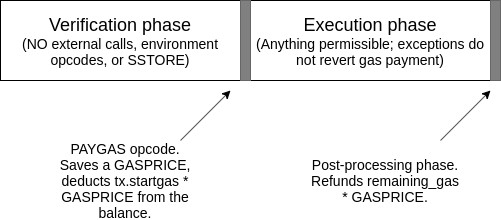
The proposal adopts a new approach to implementing account abstraction. The following sections explain its objectives and implementation approach.
Goals of account abstraction
ERC4337 aims to enable users to operate using contract accounts alone, without depending on EOAs (externally owned accounts). Specifically, it aims to allow users to use an account with arbitrary validation logic as their primary account through a smart contract wallet. This removes the need for users to hold an EOA and allows them to perform complex operations through a smart contract wallet, including the following.
- Arbitrary signature schemes (e.g., quantum-resistant signatures)
- Multisignature authorization and social recovery
- Gas payments in arbitrary tokens (e.g., ERC20 tokens)
- Wallet upgrades and custom logic
Decentralization
ERC4337 allows all interactions to take place through a public mempool.
Users do not need to know specific nodes or IP addresses, and any bundler can handle a UserOperation.
This removes dependence on centralized relays and gateways and enables more decentralized processing.
Avoiding changes to the Ethereum protocol
Changes to the consensus layer take considerable time, often requiring years of coordination and implementation. Because ERC4337 does not require consensus-layer changes, it lowers barriers to implementation and adoption and can accelerate practical deployment.
Supporting a broad range of use cases
ERC4337 can also support the following use cases.
- Privacy-preserving applications
- Atomic batches of operations (executing multiple operations together in a single transaction)
- Developer-sponsored gas fees (sponsored transactions)
- Gas payments in ERC20 tokens
- Cross-chain gas payment models
Abstracting validation (signature verification), gas payment, and execution separately greatly expands the flexibility previously available in transaction design.
Specification
Definitions
UserOperation
A structure containing the data for an operation a user wants to execute.
It resembles a conventional Ethereum transaction but is named UserOperation to distinguish it from ordinary transactions.
It includes fields such as the following (described in detail later).
tocalldatamaxFeePerGasmaxPriorityFeePerGasnoncesignature
The Ethereum protocol does not define how the signature is validated; each contract account implements its own validation logic.
Sender
A contract account that submits a UserOperation. It is an account with code rather than an EOA (externally owned account).
EntryPoint
A central contract that accepts and processes UserOperations.
Bundlers execute multiple UserOperations together through the contract's handleOps() function.
There is one such contract on the network, as described in this proposal.
Bundlers must allowlist the corresponding EntryPoint in advance.
Bundler
A node responsible for collecting UserOperations, constructing a transaction to the EntryPoint, and including it in a block. It can operate in the following ways.
- Act directly as a block builder.
- Integrate with proposer-builder separation (PBS) infrastructure using
mev-boostor compliant withEIP7732. - Use the
eth_sendRawTransactionConditionalRPC defined inERC-7796, where available.
Paymaster
A smart contract that pays gas fees on behalf of users. A Paymaster can cover gas fees in ETH even if the user does not hold ETH.
Factory
A contract that deploys a new contract account (sender) when it does not yet exist.
The address can be determined in advance using mechanisms such as CREATE2.
Aggregator
A contract that aggregates and verifies the signatures of multiple UserOperations together. Also known as an authorizer contract, it is specified in ERC7766.
Canonical UserOperation mempool
A permissionless, decentralized peer-to-peer mempool compliant with ERC7562.
Bundlers share UserOperation objects in this mempool and verify their validity.
Alternative UserOperation mempool
A separate peer-to-peer mempool that determines validity under rules other than ERC7562. It is used for optimization or specialized use cases.
Deposit
ETH (or the native currency of an L2) deposited in the EntryPoint contract in advance by a Sender or Paymaster. Gas fees are deducted from the deposit when a UserOperation executes, and the funds are used to compensate the bundler.
UserOperation
A UserOperation is a structure that allows users to execute operations through a contract account (CA).
To implement account abstraction without modifying the Ethereum protocol (consensus layer), ERC4337 processes operations using its own structure rather than the existing transaction format.
This structure is submitted to a dedicated UserOperation mempool, where bundlers aggregate and process operations.
UserOperation fields
| Field | Type | Description |
|---|---|---|
sender |
address |
Address of the contract account executing this UserOperation. |
nonce |
uint256 |
Number used to prevent replay attacks; incremented per account. |
factory |
address |
Address of the factory contract used to create a new account.For EIP7702, use 0x7702; for an existing account, use address(0). |
factoryData |
bytes |
Initialization data passed to the factory, or EIP7702 initialization information. Empty if unused. |
callData |
bytes |
Execution data passed to the sender; the main operation payload. |
callGasLimit |
uint256 |
Amount of gas allocated to executing the callData above. |
verificationGasLimit |
uint256 |
Gas allocated to the validateUserOp validation process. |
preVerificationGas |
uint256 |
Additional gas reserved for the bundler (for packing and mempool-related processing). |
maxFeePerGas |
uint256 |
Corresponds to max_fee_per_gas in EIP1559.Maximum fee allowed for the transaction as a whole. |
maxPriorityFeePerGas |
uint256 |
Corresponds to max_priority_fee_per_gas in EIP1559.Priority fee for the bundler. |
paymaster |
address |
Address of the Paymaster contract sponsoring gas fees. Zero address (0x0) for self-funded operations. |
paymasterVerificationGasLimit |
uint256 |
Gas limit for executing the paymaster validation code (only when specified). |
paymasterPostOpGasLimit |
uint256 |
Gas limit for paymaster postprocessing (postOp), only when specified. |
paymasterData |
bytes |
Additional data passed to the paymaster, potentially including a signature. |
signature |
bytes |
Signature data passed to the authentication logic within the sender. Each SCA can define its own signature structure and validation method. |
See the following article for more about EIP1559.
[EIP1559] Understanding Ethereum's new gas pricing mechanism
Security considerations
To prevent replay attacks (the risk of the same operation being executed again on another chain or through another EntryPoint), signatures must be designed to depend on chainid and the EntryPoint address.
Relationship with EIP7702
The EIP7702 authorization tuple is provided separately from the UserOperation structure.
This authorization information is supplied externally alongside the UserOperation to complement more flexible authentication methods beyond its signature.
See the following article for more about EIP7702.
[EIP7702] Understanding how EOAs can use contract-account functionality
EntryPoint interface
The EntryPoint is the central contract in ERC4337.
It is responsible for processing multiple UserOperation objects together.
For onchain efficiency and lower gas costs, a UserOperation is passed to the EntryPoint in a packed form (PackedUserOperation).
PackedUserOperation structure
| Field | Type | Description |
|---|---|---|
sender |
address |
Address of the contract account executing the operation. |
nonce |
uint256 |
Counter for preventing replay attacks. |
initCode |
bytes |
Concatenation of the factory address and initialization data for creating a new account.Also supports EIP7702. |
callData |
bytes |
Actual operation to be executed by the account. |
accountGasLimits |
bytes32 |
Concatenation of verificationGasLimit (16 bytes) and callGasLimit (16 bytes). |
preVerificationGas |
uint256 |
Additional gas compensating the bundler for validation and packing. |
gasFees |
bytes32 |
Concatenation of maxPriorityFeePerGas (16 bytes) and maxFeePerGas (16 bytes). |
paymasterAndData |
bytes |
Concatenation of the paymaster address, validation-related data, and postOp-related data (empty if unused). |
signature |
bytes |
Signature data passed to the validation logic defined by the sender. |
Efficiently packing multiple UserOperation objects in advance improves gas efficiency and enables batch processing within the EntryPoint.
handleOps
function handleOps(PackedUserOperation[] calldata ops, address payable beneficiary);The core function of ERC4337.
ops- Array of PackedUserOperation objects (multiple UserOperations).
beneficiary- Address receiving compensation for the bundler that included the UserOperation in a block, or an executor (an address that executes UserOperations, like a bundler).
The processing flow is as follows.
- The EntryPoint contract validates
opsin order, initializing wallets or Paymasters as necessary. - Execute the
callDataof validatedUserOperationobjects. - After execution finishes, pay the fee to
beneficiaryaccording to the amount of gas consumed.
This structure allows multiple UserOperation objects to be processed safely and efficiently within one transaction.
Contract account interface
IAccount
interface IAccount {
  function validateUserOp(
    PackedUserOperation calldata userOp,
    bytes32 userOpHash,
    uint256 missingAccountFunds
  ) external returns (uint256 validationData);
}
A function called by the EntryPoint contract to validate a UserOperation and pay the required gas fees.
Arguments
| Argument | Type | Description |
|---|---|---|
userOp |
PackedUserOperation calldata |
UserOperation structure to execute, including its signature. |
userOpHash |
bytes32 |
Hash including userOp (excluding the signature), the EntryPoint contract address, and chainId. |
missingAccountFunds |
uint256 |
Minimum amount to deposit into the EntryPoint contract.Cannot be zero if the sender's deposit is insufficient. |
- Verify that
msg.senderis the trusted EntryPoint contract. - If signature verification fails, returning
SIG_VALIDATION_FAILED (1)instead of reverting is recommended. However, errors other than signature failures must revert. - For gas estimation purposes, even when returning
SIG_VALIDATION_FAILED, the function should complete its processing instead of stopping early. - Pay
missingAccountFundsto the EntryPoint contract through thedepositTofunction. Excess deposits can later be withdrawn usingwithdrawTo.
Return value
The following three values must be returned in a bit-packed format.
| Variable | Description |
|---|---|
aggregator/authorizer |
Signature validation status.0 = valid signature1 = invalid signatureAny other value = Aggregator address (delegated signature verifier). |
validUntil |
Expiration of the UserOperation (UNIX timestamp of at most six bytes).Zero means no expiration. |
validAfter |
Start of the UserOperation validity period (six-byte UNIX timestamp).The operation is invalid before this time. |
IAccountExecute
An extended interface.
interface IAccountExecute {
  function executeUserOp(
    PackedUserOperation calldata userOp,
    bytes32 userOpHash
  ) external;
}
A function that executes the operation specified by callData.
Normally, the EntryPoint contract invokes the account directly to execute callData; this extension allows it to invoke this function instead.
This makes it possible to customize execution logic, including more complex controls.
Semi-abstracted Nonce Support
Conventional Ethereum transactions use a single nonce to prevent replay attacks and control transaction ordering.
However, this mechanism limits the flexibility of contract accounts in managing their own ordering and operations.
ERC4337 introduces a mechanism called the Semi-abstracted Nonce to remove this restriction while preserving security and uniqueness.
Changes to the nonce structure
ERC4337 divides UserOperation.nonce (uint256) as follows.
| Bits | Meaning | Length |
|---|---|---|
| Upper 192 bits | key (classification key) |
192 bits |
| Lower 64 bits | sequence (sequence number) |
64 bits |
This format lets one account have multiple operation categories (keys), each with independent sequencing.
Retrieving and validating nonces
The EntryPoint contract provides the following interface.
function getNonce(address sender, uint192 key) external view returns (uint256 nonce);A function that retrieves the current sequence number for the specified sender account and key.
When validating a UserOperation, a bundler needs to use this function to check the nonce in advance.
nonce requirements
- Sequence numbers must always increase in order.
- Two or more
UserOperationobjects cannot be processed simultaneously for the same key. - A new key can use any value and starts with
sequence = 0.
This enables advanced account control, such as progressing operations in different categories in parallel.
Examples
Simple ordering (sequential nonce)
To retain conventional behavior, impose the following restriction.
require(userOp.nonce < type(uint64).max);This is a simple model using only the sequence, with key = 0 fixed.
Separating administrative and ordinary operations
If a contract account needs two operation channels, administrative (ADMIN) and ordinary (NORMAL), different keys can be used for each.
bytes4 sig = bytes4(userOp.callData[0 : 4]);
uint key = userOp.nonce >> 64;

if (sig == ADMIN_METHODSIG) {
    require(key == ADMIN_KEY, "wrong nonce-key for admin operation");
} else {
    require(key == 0, "wrong nonce-key for normal operation");
}
This allows administrative and ordinary operations to proceed in parallel with independent ordering, enabling flexible operation control.
Required functionality of the EntryPoint contract
The central function of the ERC4337 EntryPoint contract is handleOps().
It processes multiple UserOperation objects together, covering validation, execution, and gas fee payments.
The processing flow is as follows.
The figures are reproduced from the original Japanese article; any Japanese labels are retained.
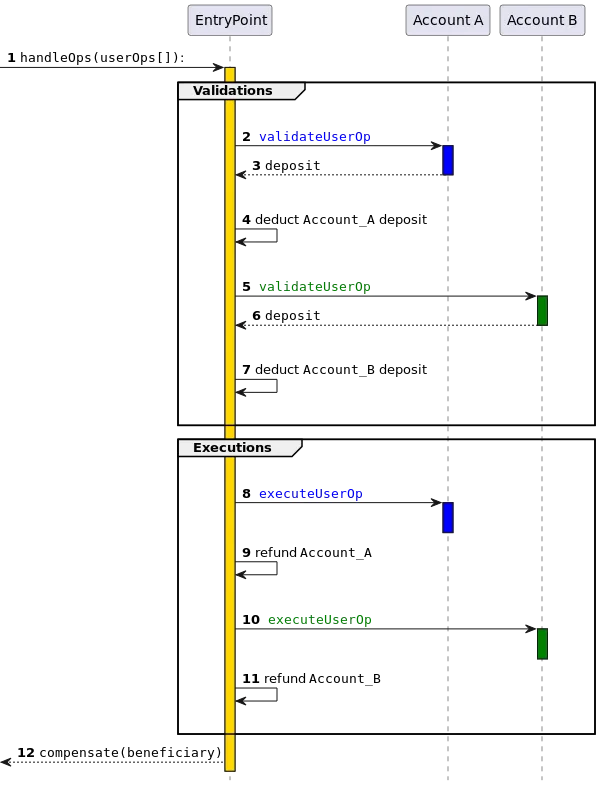
Calling handleOps
function handleOps(PackedUserOperation[] calldata ops, address payable beneficiary)ops- Array of
UserOperationobjects to process.
- Array of
beneficiary- Address receiving gas fees after processing (typically the bundler).
Verification loop
The following steps are performed for each UserOperation.
-
Create the contract account (if
initCodeis provided)- If the sender has not been deployed, it is newly deployed using
UserOperation.initCode. - If the factory contract is specified as
0x7702, verify consistency between the EOA and authorization information according to EIP7702. - Processing fails if
initCodeis empty and the sender does not exist, or if the deployment address does not match.
- If the sender has not been deployed, it is newly deployed using
-
Estimate the maximum gas fee
- Calculate the maximum payment from
validationGasLimit,callGasLimit, and the currentmaxFeePerGas.
- Calculate the maximum payment from
-
Calculate and check the required deposit
- Check whether funds are already deposited with the EntryPoint contract and calculate the shortfall as
missingAccountFunds.
- Check whether funds are already deposited with the EntryPoint contract and calculate the shortfall as
-
Call
validateUserOp()- Validate the signature and
noncefor the sender and pay the required deposit if necessary. - An invalid signature results in
SIG_VALIDATION_FAILED, whereas errors other than signature failures cause arevert. - A
UserOperationthat fails at this stage is excluded from subsequent execution (the entirehandleOpscall can alsorevertas necessary).
- Validate the signature and
-
Verify the deposit
- Finally, check that the deposit is sufficient to cover all required gas costs.
Execution loop
The following steps are performed for each successfully validated UserOperation.
-
Execute callData
- Call
callDatadirectly, or, if the initial function selector is that ofexecuteUserOp()(the IAccountExecute interface), execute the following function within the contract account.
jsexecuteUserOp(userOp, userOpHash) - Call
-
Penalty for unused gas
- When at least 40,000 gas remains unused from
callGasLimitorpaymasterPostOpGasLimit, a 10% penalty is deducted. - This prevents deliberately reserving excessive gas and blocking other transactions.
- Because a block has a maximum gas capacity, excessive gas reservations leave less room for other transactions and can delay the processing of other UserOperations.
- When at least 40,000 gas remains unused from
-
Refund remaining gas fees
- Refund the sender for the difference between the gas charged in advance and the gas actually used.
-
Pay the beneficiary
- Transfer the fees collected from all
UserOperationobjects (gasUsed × effectiveGasPrice) tobeneficiary, typically the bundler.
- Transfer the fees collected from all
Recommended bundler processing
Before accepting a UserOperation, a bundler is encouraged to simulate EntryPoint.handleOps() locally.
This enables the following preliminary checks.
- Whether the signature is valid
- Whether the deposited gas funds are sufficient
- Whether the gas fees will be paid correctly
A failing UserOperation must not be added to the mempool or propagated to other nodes.
JSON-RPC API in ERC4337
ERC4337 requires additional endpoints in the standard Ethereum JSON-RPC API so that users can submit a UserOperation rather than a conventional transaction.
This allows bundlers to receive UserOperation objects and relay and share them through a peer-to-peer mempool.
Main JSON-RPC methods
Two methods are particularly important in ERC4337.
These RPC interfaces are defined in ERC7769. Following this specification allows wallets, applications, and bundlers to communicate using a common protocol.
See the following article for more about ERC7769.
[ERC7769] Understanding the JSON-RPC API for ERC4337-compliant contract accounts
eth_sendUserOperation
A method for submitting a UserOperation object to a bundler node.
The submitted UserOperation is added to the bundler's local mempool and relayed to other nodes.
eth_getUserOperationReceipt
A method for retrieving the execution result (receipt) of the specified UserOperation.
If it has executed, information such as the following is returned.
- Number and hash of the block in which it executed
- Processing result from the EntryPoint contract
- Success or failure status
- Amount of gas used
EIP712 signature support
ERC4337 supports EIP712 signatures to provide flexibility in validating signatures over a UserOperation.
EIP712 is a standard for signing structured data.
See the following article for more about EIP712.
[EIP712] Understanding typed structured data hashing and signing
Generating userOpHash
The hash identifying a UserOperation and used as signing data (userOpHash) consists of the following two steps in accordance with EIP712.
Hash of the domain information (TYPE_HASH)
First, hash the following information to define the signing domain.
bytes32 constant TYPE_HASH =
    keccak256(
        "EIP712Domain(string name,string version,uint256 chainId,address verifyingContract)"
    );
The domain information includes the following.
| Field | Description |
|---|---|
name |
Name of the EIP712 message |
version |
Version information |
chainId |
Chain ID (e.g., 1 for Ethereum Mainnet) |
verifyingContract |
Verifying contract (the EntryPoint contract address) |
This hash is used to ensure uniqueness of the signing domain.
Hash of the PackedUserOperation type information
Define the data structure corresponding to the body of the UserOperation as follows and hash its type information.
bytes32 constant PACKED_USEROP_TYPEHASH =
    keccak256(
        "PackedUserOperation(address sender,uint256 nonce,bytes initCode,bytes callData,bytes32 accountGasLimits,uint256 preVerificationGas,bytes32 gasFees,bytes paymasterAndData)"
    );
The structure contains transaction details, including the sender, call contents, and gas limits. The signing hash is generated based on this type.
EIP7702 signed authorization support
By supporting EIP7702, ERC4337 enables a flexible transition from EOAs (externally owned accounts) to contract-account functionality and specialized authorization processing.
The data structure (tuple) containing authorization information, which grants a CA permission to execute a particular operation, contains the following data.
- EOA address providing the authorization
- Contract account receiving the authorization
- Signature data for the authorization (signed by the EOA)
By attaching this tuple to a UserOperation, the EOA can authorize the contract account in advance to treat the operation as legitimate.
The eip7702Auth parameter in eth_sendUserOperation
On networks where EIP7702 is enabled, the eth_sendUserOperation RPC method supports an additional parameter called eip7702Auth.
eip7702Authmust be an EIP7702-compliant authorization tuple.- It must be signed by the sender (the user's EOA).
The bundler aggregates the eip7702Auth entries included with all UserOperation objects into an authorizationList and executes the bundle using the special transaction type SET_CODE_TX_TYPE.
Special processing with initCode (EIP7702 support)
When a UserOperation has a specially formatted initCode, the following processing occurs.
Ordinary initCode processing
- First 20 bytes
- Factory contract address
- Remaining bytes
- Initialization
calldatapassed to the factory contract
- Initialization
The EntryPoint contract calls the factory contract to create the CA.
Special processing for EIP7702
initCodestarts with0x7702(the EIP7702 flag).- The following bytes of the address portion are zero-padded.
The UserOperation is treated as using a contract account established through delegation by an EOA rather than through a factory contract.
In this case, when computing the hash (userOpHash), replace the factory address normally at the beginning of initCode with the delegation target contract address obtained through the EXTCODECOPY opcode.
The remaining portion of initCode (after the first 20 bytes) is used to invoke the contract account's own initialization logic.
This design provides flexibility by allowing an EOA to initialize its own authorized account directly without using a factory contract.
It is also possible for initCode to be empty.
In that case, the EntryPoint contract does not include the EIP7702 delegation information in the hash, and the operation executes against the existing account.
Gas cost of authorization processing
Each EIP7702 authorization requires PER_EMPTY_ACCOUNT_COST = 25000 gas.
This gas consumption occurs outside the EntryPoint contract and cannot be measured by it.
Users must therefore account for that gas by increasing preVerificationGas accordingly.
Extending sponsorship through a Paymaster
Adding a Paymaster to the ERC4337 EntryPoint processing flow enables a variety of use cases, such as application developers sponsoring users' gas fees or users paying fees with ERC20 tokens.
The following flow is used.
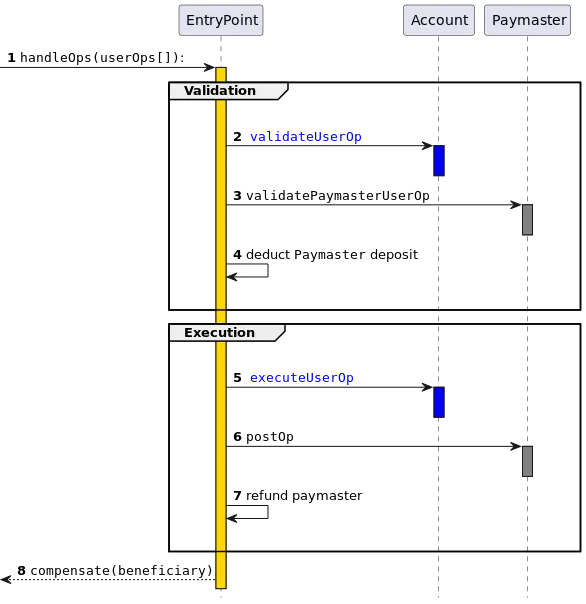
Processing a UserOperation with a Paymaster
If the UserOperation has a nonempty paymasterAndData field, EntryPoint.handleOps() performs the following extended processing.
Validation phase
-
Call the account's
validateUserOp- The call uses
missingAccountFunds = 0(the account's deposit is not used).
- The call uses
-
Check the Paymaster deposit
- Verify whether the Paymaster has deposited enough ETH with the EntryPoint contract to pay the fees.
-
Paymaster validation
- Call
validatePaymasterUserOp(userOp, userOpHash, maxCost). - If the returned
contextis nonempty, it is used in the subsequentpostOpcall. validationDatais used for signature verification and validity periods, among other purposes.
- Call
context is arbitrary byte data returned by the Paymaster's validatePaymasterUserOp() function.
This context is generated during validation and passed unchanged to postOp() during execution.
This mechanism allows values temporarily calculated or retrieved by the Paymaster during validation to be retained and reused during subsequent processing. Examples include the following.
- A token-payment Paymaster retrieves the user's token balance or the exchange rate for calculating fees.
- Temporarily retain state or access information associated with the account.
This allows the Paymaster to save gas while passing the required information to postOp() and implementing logic such as charging or refunds based on the operation's success or failure.
validationData is bit-packed data of type uint256 returned by validatePaymasterUserOp() or validateUserOp().
| Field | Contents |
| Lower 20 bits | Signature verification result (e.g., 1 = invalid signature) |
| Middle 64 bits | validUntil: expiration time of the UserOperation |
| Upper 64 bits | validAfter: start of the UserOperation validity period |
This data allows a UserOperation to be valid only within a specified time range and enables control of signature validity and deadlines.
Execution phase
-
Execute the account's executeUserOp function (or call callData)
-
Call
postOpon the Paymaster if necessary- If the
contextreturned byvalidatePaymasterUserOpis nonempty, the call takes the following form.
jspostOp(mode, context, actualGasCost, actualUserOpFeePerGas)modehas one of the following values.opSucceeded- If the
UserOperationsucceeds
- If the
opReverted- If the
UserOperationfails (the Paymaster still pays gas fees)
- If the
- If the
How the Paymaster pays gas fees
The Paymaster pays the user's gas fees using its deposit in the EntryPoint contract.
The Paymaster must make this deposit in advance using EntryPoint.depositTo().
Establishing trust through staking
To mitigate denial-of-service attacks by malicious Paymasters, such as the following, Paymasters are encouraged to maintain a stake (locked ETH).
- Pass validation but deliberately
revertduring execution. - Consume excessive gas, affecting the bundler and other UserOperations.
Requiring ETH to be locked for a period through addStake() allows mechanisms such as temporarily suspending transaction acceptance when problematic behavior is detected.
Stake management functions (EntryPoint)
function addStake(uint32 _unstakeDelaySec) external payable;
function unlockStake() external;
function withdrawStake(address payable withdrawAddress) external;addStake- Lock ETH as a stake.
- Specify
unstakeDelaySec, the waiting period before the stake can be unlocked.
unlockStake- Request unlocking (a waiting period is required).
withdrawStake- Withdraw the stake after unlocking.
Deposit management (EntryPoint)
function balanceOf(address account) public view returns (uint256);
function depositTo(address account) public payable;
receive() external payable;
function withdrawTo(address payable withdrawAddress, uint256 withdrawAmount) external;depositTo- Add ETH to the specified account's deposit.
withdrawTo- Withdraw ETH from the deposit.
balanceOf- Check the current deposit balance.
Accounts as well as Paymasters can manage deposits using the same interface.
Bundler behavior: processing a received UserOperation
In ERC4337, a bundler receives UserOperation objects and submits them to the EntryPoint contract.
This resembles the flow leading to ordinary Ethereum transaction execution, but involves multiple validation stages and mempool controls, requiring more sophisticated processing.
The following describes bundler behavior and the associated validation logic.
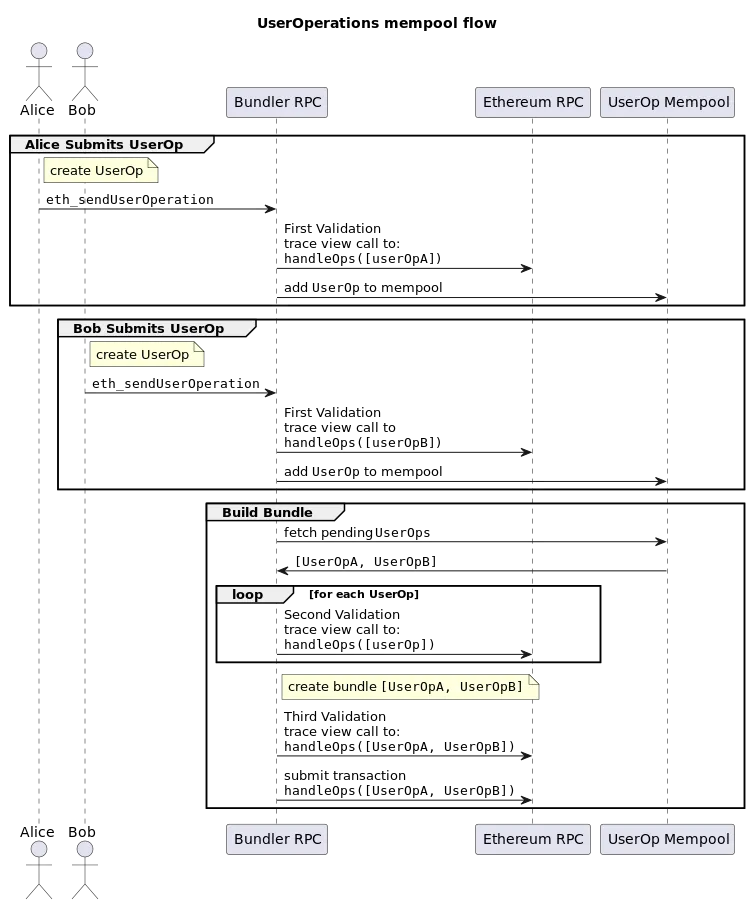
Basic bundler processing steps
-
Receive a UserOperation
- The client invokes the
eth_sendUserOperationRPC method and sends aUserOperationto the bundler.
- The client invokes the
-
First validation (on receipt)
- The bundler performs initial validation before adding the UserOperation to the mempool.
- A
UserOperationthat fails this validation is discarded and an error is returned.
-
Second validation (during bundle construction)
- When constructing a bundle from the
UserOperationobjects in the mempool, revalidate eachUserOperation. - Add valid operations to the bundle and skip those that fail.
- When constructing a bundle from the
-
Third validation (immediately before block submission)
- Validate the entire constructed bundle again.
- If invalid
UserOperationobjects are found, remove them and update reputation scores (see ERC7562 for details).
See the following article for more about ERC7562.
[ERC7562] Understanding transaction validation rules for account abstraction
Initial validation
A bundler performs the following basic checks before adding a UserOperation to its mempool.
| Check | Description |
|---|---|
| Account existence consistency | The sender is an existing contract or initCode is nonempty (exactly one of these conditions). |
initCode format |
Its first 20 bytes are a factory contract address or the 0x7702 flag. |
| Factory stake status | A factory contract that reads global state must be staked. |
| Verification gas limit | verificationGasLimit and paymasterVerificationGasLimit are below MAX_VERIFICATION_GAS (=500000). |
preVerificationGas |
Covers the gas cost of serialized calldata plus PRE_VERIFICATION_OVERHEAD_GAS (=50000). |
| Paymaster validity | If paymasterAndData is nonempty:1. Contract code exists. 2. Its deposit is sufficient. 3. It is not banned. |
callGasLimit |
Exceeds the minimum gas required for a CALL with value. |
| Minimum fee settings | maxFeePerGas and maxPriorityFeePerGas meet the base fee and bundler-configured minimums. |
| Sender uniqueness | There is no existing UserOperation with the same sender and nonce (if one exists, replacement is allowed only with a higher fee).Only staked senders are exceptionally permitted multiple UserOperation objects. |
Example of bundle construction and block submission
- Alice and Bob submit
UserOperationobjects, which reach the bundler RPC. - The bundler adds them to its mempool (only after validation).
- When constructing a bundle for the next block, the bundler validates them again.
- A bundle containing only successfully validated
UserOperationobjects executes throughEntryPoint.handleOps().
UserOperation simulation
ERC4337 introduces simulation to validate a UserOperation in advance.
Unlike ordinary Ethereum transaction validation, this is necessary to accommodate UserOperation objects whose validation results may change depending on EVM state or other transactions.
Why simulation is necessary
Ordinary Ethereum transactions permit static checks such as the following.
- Verify the signer (EOA) using
ecrecover. - Check whether the
noncematches the EOA's currentnonce. - Check whether the account balance is sufficient.
- Check whether
gasLimitexceeds the base cost. - Check whether
chainIdmatches the current chain.
The original explanation describes these checks as simple because they do not depend on other transactions or EVM state.
By contrast, a UserOperation requires state-dependent validation such as the following.
- Call
account.validateUserOp.- Function that validates the
UserOperation.
- Function that validates the
- Call
paymaster.validatePaymasterUserOp.- The Paymaster verifies gas payment.
- Deploy the contract account using
initCode. - Check time restrictions (
validAfter,validUntil).validAfter- Start time at which the
UserOperationbecomes valid (Unix timestamp).
- Start time at which the
validUntil- Time at which the
UserOperationexpires.
- Time at which the
Simulation is introduced because safely checking these state-dependent operations in advance requires executing the UserOperation provisionally on the EVM and inspecting the results.
Simulation specification
How to execute it
The bundler makes a read-only call to handleOps() containing only the target UserOperation.
This is not written to the chain and is used for offchain validation.
Simulation scope
Only the validation phase is simulated; the execution phase (executing callData) is outside the required scope.
To terminate simulation early, a UserOperation that always fails may also be included as the second operation in the bundle's array.
Validation steps
Simulation performs the following checks.
- Create the sender account if
initCodeis present. - Call
account.validateUserOp(). - Call
paymaster.validatePaymasterUserOp()if a Paymaster is specified. - If the return values from
validateUserOporvalidatePaymasterUserOpcontainvalidAfter/validUntil, check that the current block time is within that range.
Notes
- If simulation fails, the
UserOperationis considered invalid and discarded from the mempool. - If a
UserOperationis about to expire (itsvalidUntilis too close), the bundler must also discard it. - The bundler needs to decode the return values using an EVM trace to check
validAfter/validUntil.
DoS mitigation and restrictions
The following restrictions are necessary to protect bundlers against denial-of-service attacks during simulation.
- Restrict the opcodes and storage operations permitted within
validateUserOp()andvalidatePaymasterUserOp(). - These rules are defined by ERC7562 and are designed to ensure simulation can complete safely.
Estimating preVerificationGas
In ERC4337, preVerificationGas represents the gas required before executing a UserOperation onchain.
It accounts for fixed gas costs associated with transmitting and validating UserOperation data so the bundler can recover its costs appropriately.
What is preVerificationGas?
preVerificationGas covers the gas required for transmitting the calldata containing the UserOperation's execution data, fixed data, and static memory allocation.
It covers the minimum overhead incurred before the EntryPoint contract's validation processing, separately from actual execution (executing callData).
To process a UserOperation safely, the bundler must estimate this value accurately.
If the estimate is inadequate, transaction processing may fail or the bundler may be unable to recover its upfront costs.
Components of the estimate
The specification does not prescribe a standard calculation formula, but the following costs must be included.
Base transaction cost
An Ethereum transaction requires at least 21000 gas.
This cost is divided according to the number of UserOperations in the bundle.
Example: a bundle with three UserOperations → 21000 / 3 = 7000 gas.
calldata gas costs (EIP2028-compliant)
Each byte of calldata incurs gas according to its value.
- Zero byte
4gas
- Nonzero byte
16gas
See the following article for more about EIP2028.
[EIP2028] Understanding the proposal to reduce calldata gas costs
Processing static code in the EntryPoint contract
Gas for executing static code inside the EntryPoint contract associated with the validateUserOp call.
Memory loading cost for fixed-length fields
Static memory usage when loading fixed fields of the UserOperation structure (e.g., nonce and sender) into EVM memory.
Memory cost of the context from the Paymaster's validatePaymasterUserOp (optional)
If the Paymaster returns context, include gas consumed in reading, expanding, and retaining the associated memory.
External call gas for innerHandleOp()
- The cost of invoking
innerHandleOp(), a major part of the EntryPoint contract's internal processing. - This cost varies depending on the operation's position within the bundle.
EIP7702 authorization cost (optional)
- If an EIP7702 authorization is included, an additional
25000 gasis expected.
EIP7623 calldata gas floor
- Based on the new
tx.gasUsedcalculation, use the following estimated values.- Total gas consumed by validation during simulation (account creation,
validateUserOp, and the Paymaster). - 10% of the combined execution and postOp gas.
- Total gas consumed by validation during simulation (account creation,
Bundler requirements
preVerificationGas needs a margin for future memory expansion and changes in the operation's position within the bundle.
Estimating preVerificationGas at the absolute minimum creates the following risks.
- Execution of
validateUserOp()inside the EntryPoint contract fails because of insufficient gas. - Insufficient gas causes the entire UserOperation to fail, potentially affecting other bundled operations.
- The bundler is unable to recover part of the gas fees it paid.
Alternative mempools
ERC4337 defines strict simulation rules to preserve security when validating a UserOperation.
These help prevent denial-of-service attacks from malicious Paymasters and network instability.
However, some Paymasters may be disallowed by the standard rules despite being demonstrably safe.
Alternative mempools were introduced to accommodate such situations.
Why alternative mempools are needed
Conventional mempools strictly apply the opcode and storage access restrictions defined in ERC7562. This is intended to prevent unknown or malicious Paymasters from behaving improperly during simulation. However, some use cases require Paymasters to operate without these constraints.
What is an alternative mempool?
A mechanism for applying custom validation rules that differ from those of the conventional mempool. It is used to relax particular restrictions (e.g., on opcode usage or gas limits) and operates as an independent mempool within a peer-to-peer network shared by a subset of bundlers. This enables more flexible validation rules, such as allowing only Paymasters that meet specified conditions.
Why a simple allowlist is insufficient
If individual bundlers simply accept a Paymaster because they consider it safe, the UserOperation may propagate only to a subset of bundlers, fragmenting the network.
This makes behavior unpredictable for users and undermines network-wide consistency.
Alternative mempools as a solution
All participating bundlers explicitly signal their adoption of a particular set of relaxed rules and establish a separate mempool with common validation and propagation rules.
This ensures that UserOperation objects complying with the relaxed rules can be propagated and processed reliably across participating bundlers.
ERC7562
The definitions and rules for alternative mempools are specified in ERC7562. It also describes which rules can be relaxed, how bundlers propagate operations, and how reputation is handled.
See the following article for more about ERC7562.
[ERC7562] Understanding transaction validation rules for account abstraction
Bundling
Bundling is the process of collecting multiple UserOperation objects and submitting them to the blockchain as a single transaction.
Required processing during bundling
A bundler must satisfy the following conditions when constructing a bundle.
- Exclude any
UserOperationthat accesses the sender address of anotherUserOperation. - Also exclude any
UserOperationthat accesses an address created by a factory contract during validation of anotherUserOperation. - For multiple
UserOperationobjects using the same Paymaster, track the Paymaster's balance and verify that it can cover all fees.
Validation after constructing the transaction
Before including a bundle in a block, bundlers are encouraged to perform the following checks.
- Run a simulation using
debug_traceCallwith the maximum available gas to verify that the entirehandleOpscall executes correctly. (Also check for violations of opcode and storage access restrictions.) - If simulation fails, identify the contract account most recently invoked by a
CALLfrom the EntryPoint contract and treat it as the cause. Note that bundlers should avoid determining the cause solely from the reportedFailedOpevent.
Handling invalid UserOperation objects
Any invalid UserOperation must be removed from both the bundle and the mempool.
If the failure is attributable to a factory contract or Paymaster, proceed as follows.
- If the sender is not staked:
- Ban the factory contract or Paymaster.
- If the sender is staked:
- Ban the sender instead of banning the factory contract or Paymaster.
- Repeat these adjustments until
debug_traceCallsucceeds.
Security considerations
Staked entities (sender, factory contract, or Paymaster) may temporarily share data with other UserOperation objects.
Therefore, the same restrictions (prohibited opcodes and storage access restrictions) must apply to validation of the entire handleOps call, just as they do to individual UserOperation objects.
Otherwise, an attacker may use prohibited opcodes to distinguish onchain execution and deliberately trigger a FailedOp event.
Considerations when including a bundle in a block
Prevent UserOperation failures caused by preceding transactions in the block.
The following measures are recommended.
- Use EIP2930 access lists to avoid conflicts.
- Alternatively, place the bundle as the first transaction in the block.
See the following article for more about EIP2930.
[EIP2930] Understanding the proposal to introduce a new transaction type with an access list
Handling error codes
The EntryPoint contract must revert when an error occurs during validation of a UserOperation.
However, the bundler needs to determine accurately which entity (sender, factory contract, or Paymaster) caused the error.
Identifying the source of an error
The entity responsible for the failure (sender, factory contract, or Paymaster) is identified as follows.
Use the call trace to identify the contract invoked through CALL immediately before the revert that occurred during EntryPoint processing.
A call trace is a record of the call history of operations executed on the EVM.
During EVM execution, one contract may invoke a function on another contract using the CALL opcode.
A call trace reveals in detail which contracts invoked which functions and in what order.
Call traces can be retrieved through RPC methods such as debug_traceCall.
- The last entity invoked (sender, factory contract, or Paymaster) is treated as the source of the error.
Error formats
The EntryPoint contract must revert using only the following explicit error types during simulation or actual execution.
SignatureValidationFailed()FailedOp()FailedOpWithRevert()
This enables bundlers to identify the cause accurately in combination with call-tracing.
Error code conventions (AA##)
Each error has an identifying code (AA##), with the prefix identifying the error category.
| Error code | Where it occurs | Meaning |
|---|---|---|
AA1x |
Sender creation | Account creation error in the factory |
AA2x |
Sender validation | Error executing validateUserOp |
AA3x |
Paymaster validation | Error executing validatePaymasterUserOp |
These error codes allow the error category to be identified quickly.
Additional notes
Separating validation and execution as a DoS mitigation
When implementing account abstraction solely through contract accounts, one difficulty is that it would otherwise be necessary to execute an operation to determine whether its gas fees will actually be paid.
Such a mechanism would permit denial-of-service attacks in which an attacker submits many malicious UserOperation objects that revert at the end of execution, imposing excessive load on bundlers and block builders.
To prevent this, ERC4337 separates validation (signature verification and checking the ability to pay) from execution.
Accounts implement validateUserOp, which verifies signatures and confirms payment in advance. Execution using callData occurs only when validation succeeds.
Improving security through validation restrictions
Restrictions on storage and opcodes used during validation prevent bundlers from inadvertently including invalid UserOperation objects.
These restrictions address cases such as the following.
- A
UserOperationthat passes validation individually but fails when included in a block. - A
UserOperationthat fails validation because it interferes with anotherUserOperation.
To prevent these cases, bundlers must accept UserOperation objects according to the validation rules defined in ERC7562.
Reputation-based controls and throttling
Global entities such as Paymasters and factory contracts are shared by multiple UserOperation objects, so one instance of misbehavior can invalidate multiple operations.
The following mechanisms help prevent this.
- Entities that invalidate
UserOperationobjects at a certain rate are subject to throttling (reduced processing rates) or temporary bans from the mempool. - Requiring a stake (a deposit of ETH) raises attack costs and mitigates Sybil attacks involving the creation of many fake entities.
- Stakes are not confiscated or slashed and can be withdrawn after the specified
unstakeDelay.
Gas abstraction through a Paymaster
A Paymaster is a contract that allows someone other than the transaction sender to cover gas fees. For example, a token Paymaster that accepts ERC20 tokens for gas fees can charge the maximum estimated payment in advance and refund the excess to the user after execution.
Initial creation of a contract account
A factory contract is used to create a contract account.
By generating its address deterministically using CREATE2 (opcode 0xF5), the address can be predicted even before the account is created.
- The
initCodefield contains the 20-byte factory contract address and initializationcalldatapassed to it. - The
UserOperationis aborted if executinginitCodedoes not create a contract at the specified sender address, or if the contract at that address is not the expected one. - If a factory contract accesses storage, it needs a stake as a DoS mitigation.
This mechanism allows users to prepare an address and send funds to it safely without deploying the contract in advance. It provides the experience of an account that can receive funds immediately, just like an EOA.
Compatibility
Because ERC4337 does not change Ethereum's consensus layer (the underlying mechanism responsible for block production and transaction finality), it does not introduce compatibility problems for Ethereum as a whole.
However, it is not directly compatible with contract accounts created before ERC4337.
These accounts do not implement validateUserOp, a key function in ERC4337.
If an existing account has a mechanism for allowing trusted UserOperation senders, such as access control through authorized controllers, compatibility can be maintained by creating an ERC4337-compliant account that wraps the original account's validation logic and configuring the new account as a trusted sender.
Reference implementation
Security considerations
Because the EntryPoint contract is central to all operation processing in ERC4337, it requires thorough auditing and formal verification. This design reduces the responsibilities of individual contract accounts and limits the scope they need to verify, but the EntryPoint becomes a single point of failure and therefore needs to be highly robust.
EntryPoint security
Two points are particularly important when verifying the EntryPoint contract.
-
Preventing unauthorized calls The EntryPoint must execute
callDataonly for a sender account whosevalidateUserOphas already succeeded. -
Preventing improper fee payments Only when
validateUserOpsucceeds must the EntryPoint execute thecallDataspecified by the UserOperation.
Secure caller verification by each contract
Under the EntryPoint security model, each contract must restrict callers as follows.
-
Factory contracts Verify that
createAccount()is called only fromentryPoint.senderCreator(). -
Paymaster contracts Restrict
validatePaymasterUserOp()andpostOp()to calls from the EntryPoint. -
Aggregator contracts Restrict
validateSignatures()to calls from the EntryPoint contract. -
EIP7702-based accounts Restrict the initialization function to calls from
entryPoint.senderCreator(), and ensure that the same initialization code cannot run multiple times.
Because the EntryPoint itself cannot determine whether an EIP7702 account has been initialized, wallet applications should avoid repeatedly submitting initCode.
Additional considerations for contract accounts
- Avoiding storage layout collisions Many accounts are designed to be upgradeable and must avoid storage collisions between different implementations. Techniques such as the diamond storage pattern defined by ERC7201 are recommended.
See the following article for more about ERC7201.
[ERC7201] Understanding efficient namespaced storage management
- Handling transient storage
When using transient storage defined by EIP1153, remember that ERC4337 may include multiple
UserOperationobjects from different senders within one transaction. Manually clean up transient storage if it is used for access control or sensitive information.
References
Vitalik Buterin (@vbuterin), Yoav Weiss (@yoavw), Dror Tirosh (@drortirosh), Shahaf Nacson (@shahafn), Alex Forshtat (@forshtat), Kristof Gazso (@kristofgazso), Tjaden Hess (@tjade273), "ERC-4337: Account Abstraction Using Alt Mempool [DRAFT]," Ethereum Improvement Proposals, no. 4337, September 2021. [Online serial]. Available: https://eips.ethereum.org/EIPS/eip-4337.
Related articles on AA and ERC4337
This section collects accessible articles about AA (Account Abstraction) and ERC4337. Use the resources in this section for further reading.
Understanding account abstraction (ERC4337) by following concrete processing steps

Account abstraction study session

A world centered on contract wallets beyond AA (Account Abstraction)
Applying signature aggregation to AA (Account Abstraction)
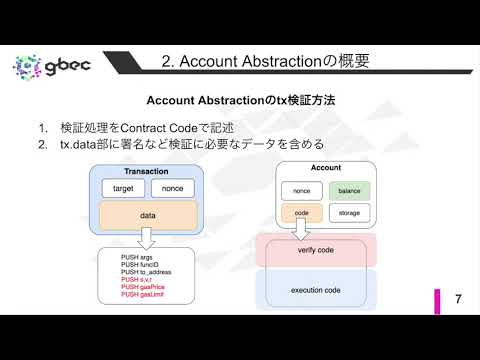
Learning blockchain through video: Ethereum account abstraction — 中城元臣
Understanding account abstraction through ERC4337

What is account abstraction?
ERC 4337: account abstraction without Ethereum protocol changes
Misconceptions and truths about account abstraction
ERC-4337 Documentation
ERC-4337 Progress report
[EIP-4337] From submitting a UserOperation to a bundler to issuing a transaction

Ethereum wallets today and tomorrow — EIP-3074 vs. ERC-4337
The power of account abstraction: technical overview of RaisePay Wallet
Why we need wide adoption of social recovery wallets
https://vitalik.ca/general/2021/01/11/recovery.html
Conclusion
This article covered ERC4337, a proposal for implementing account abstraction without changing the protocol. I hope the explanation was useful.
If you have any questions, feel free to contact me through Twitter direct messages using the link below.