Introduction
Hi, I'm cardene, a software engineer and technical writer focused on blockchain and AI.
I've also authored Japanese technical books on specification-driven development with LLMs and decentralized application (DApp) development.

I also build and publish a variety of tools, libraries, and open-source projects.
This article examines EIP-7002, which allows exits and withdrawal requests to be initiated from the execution layer using the withdrawal credential, the information identifying the recipient of staked ETH withdrawals.
The explanation is based on the specification linked below.

Passing withdrawal requests from the execution layer to the consensus layer gives the party controlling the withdrawal credentials greater authority to initiate an exit.
Although the original EIP's motivation focuses on 0x01, Electra's consensus-layer processing authenticates source addresses associated with both 0x01 and 0x02 execution-layer withdrawal credentials.
The partial withdrawal path imposes additional conditions: submitting amount > 0 does not automatically result in a partial withdrawal.
The original diagrams are retained and may contain Japanese labels.
Overview
EIP-7002 enables validator exit and withdrawal requests to originate from the execution layer. The request itself goes to an execution-layer contract, but the consensus layer performs final processing.
Ethereum validators have two principal types of credentials.
One is the active key used for routine signing; the other is the withdrawal credential identifying where withdrawals go.
The active key is typically a hot key used online. Withdrawal credentials, by contrast, are closely associated with ultimate control of the assets, so the authority associated with them can be managed more securely, including through cold storage.
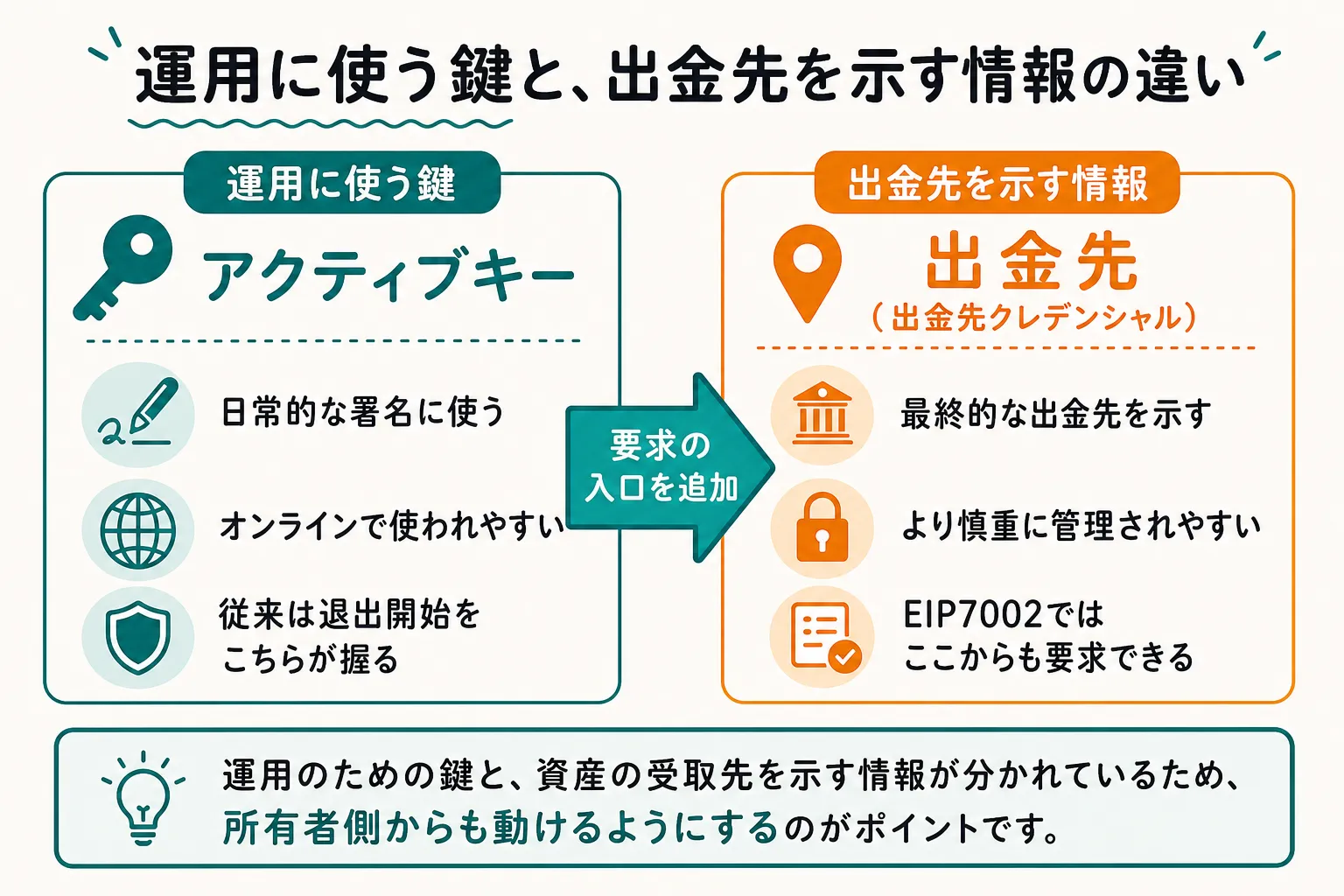
The diagram contrasts the active key used for routine operations with the withdrawal credential identifying the final recipient of funds. Before EIP-7002, the party operating the validator controlled exit initiation. EIP-7002 provides an entry point to the party controlling the withdrawal address as well.
The objective of EIP-7002 is to let the party controlling the withdrawal credentials initiate exits or withdrawal requests. This makes it easier for the ultimate owner to initiate an exit even if an operator or separate administrator entrusted with the active key does not cooperate.
How It Differs from EIP-4895
EIP-4895 addresses a related subject but serves a different purpose. EIP-4895 applies withdrawals determined by the consensus layer to the EVM. EIP-7002 instead creates an execution-layer entry point for requesting a withdrawal or exit before that outcome is determined.
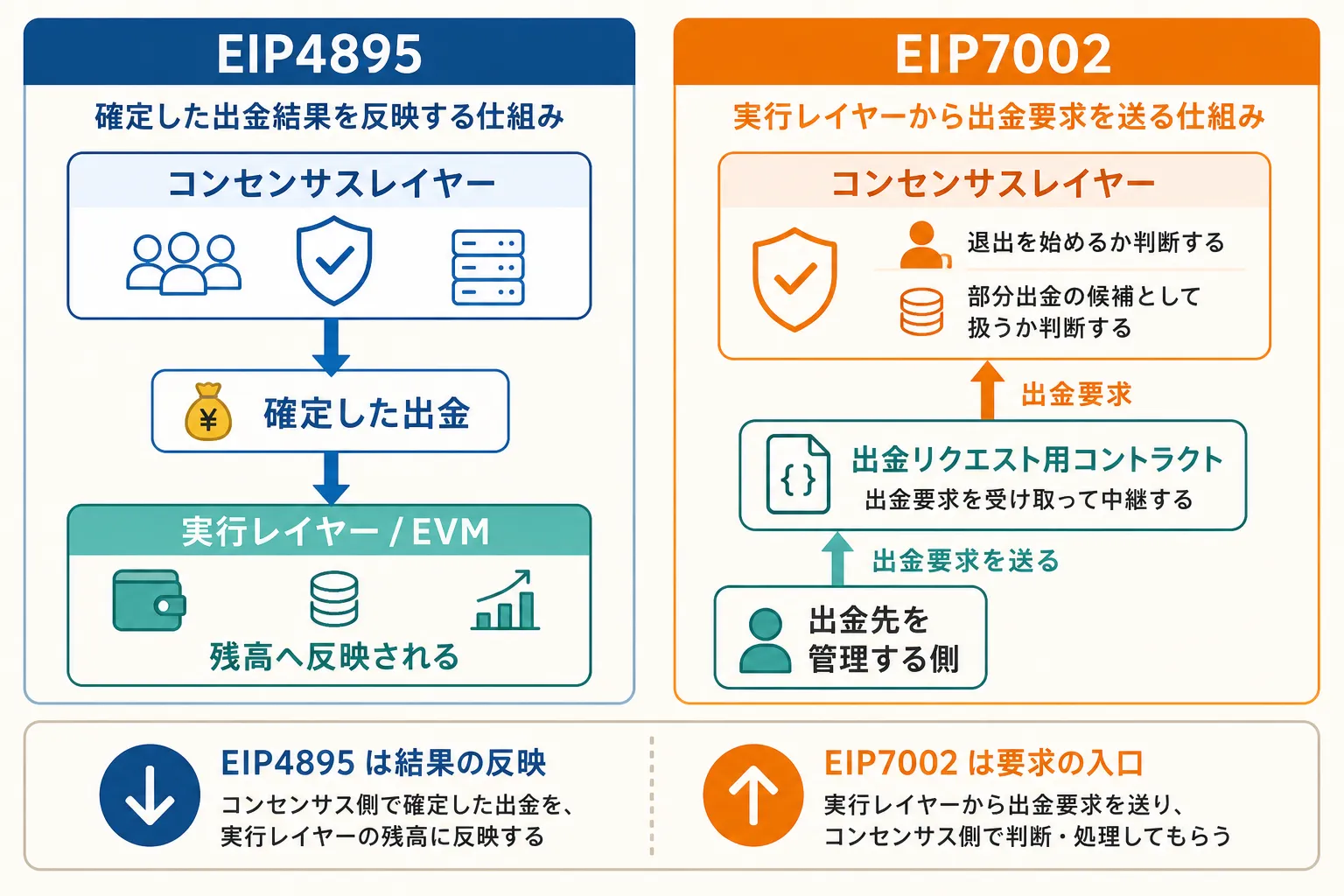
The diagram contrasts EIP-4895 on the left, which applies withdrawal results from the consensus layer (CL) to the execution layer (EL), with EIP-7002 on the right, which passes withdrawal requests from the EL to the CL. Both concern withdrawals, but they operate in opposite directions: EIP-4895 applies the result, whereas EIP-7002 supplies the request entry point.
For background on EIP-4895, see the following article.
[EIP-4895] Validator Withdrawals from the Beacon Chain to the EVM
Relationship to EIP-7685
EIP-7002 does not independently define a new block format. It builds on the general-purpose request framework introduced by EIP-7685.
EIP-7002 defines a specific withdrawal request type, while EIP-7685 provides the common transport mechanism for moving request data from the EL to the CL.
In Electra, these requests appear in the withdrawals list of ExecutionRequests under block.body.execution_requests.
They are then converted by get_execution_requests_list() into byte strings consisting of a type byte followed by an SSZ list, and passed to the engine in ascending request-type order.
For background on EIP-7685, see the following article.
Motivation
Before EIP-7002, the party controlling the active key was responsible for instructing a validator to initiate an exit. The Ethereum specification calls this exit initiation procedure a voluntary exit. However, the party controlling the withdrawal credentials is more closely associated with ownership of the staked ETH.
This mismatch creates several problems.
| Problem | Consequence |
|---|---|
| Separate active-key administrator and asset owner | An owner who wants to exit cannot proceed without cooperation from the active-key holder |
| Complex custody arrangements | An unresponsive operator may effectively hold assets hostage |
| Loss of the active key | The normal exit flow cannot be initiated even when the owner wants to exit |
The important point is that withdrawal credentials already identify the final recipient of the staked assets. A division of responsibilities in which that party cannot initiate an exit is therefore awkward.
EIP-7002 addresses this mismatch by allowing an EOA or smart contract associated with execution-layer withdrawal credentials to initiate exits or withdrawal requests.
The EIP also explains that a holder of only 0x00 withdrawal credentials can use the mechanism after a one-time signed transition to 0x01.
Rather than viewing it as a specialized feature limited to 0x01, it is useful to understand the specification as a transfer of control toward the withdrawal-credential holder.
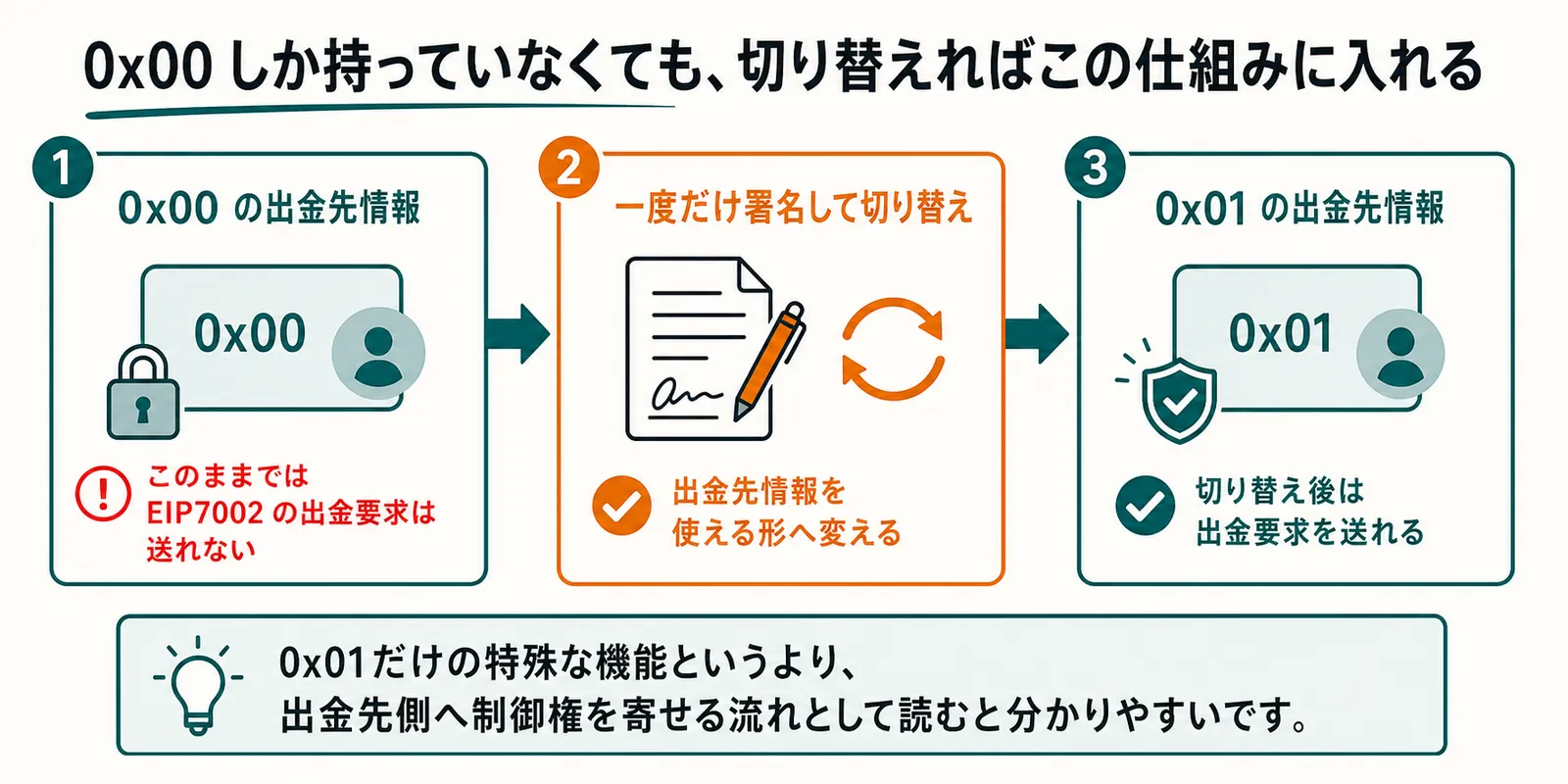
The diagram shows that the credentials need not start with 0x01: holders of 0x00 credentials can use the mechanism after the one-time transition.
EIP-7002 is best understood as part of a broader move toward withdrawal-address control, not as a feature for a narrow set of withdrawal recipients.
Specification
End-to-End Flow
Start with the overall flow. A withdrawal-request contract deployed at a designated execution-layer address receives withdrawal requests. At the end of the block, the requests are dequeued, included in the EIP-7685 requests list, and processed by the consensus layer.
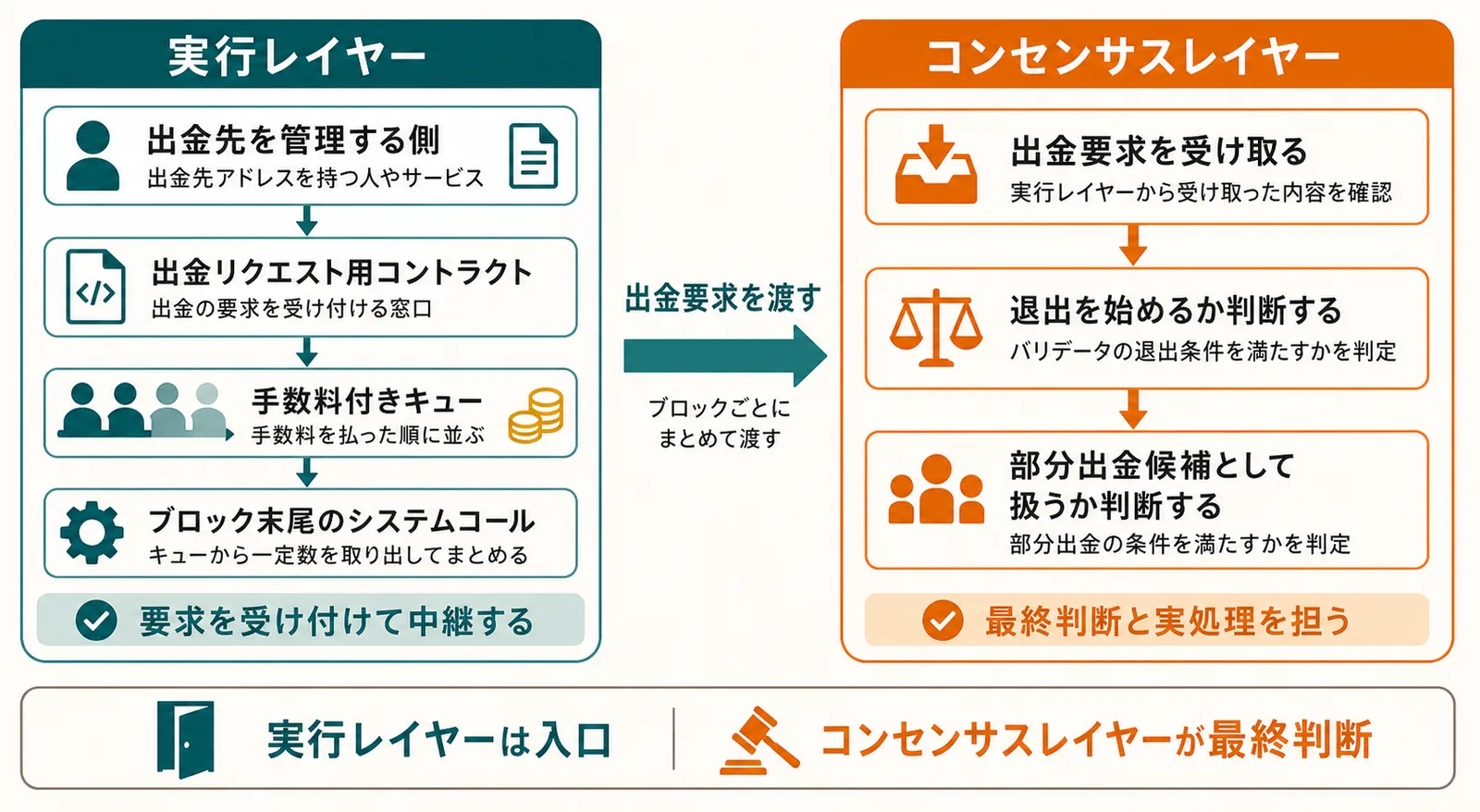
On the left, the party controlling the withdrawal credentials sends a request to the execution-layer withdrawal-request contract, where it is placed in a fee-bearing queue. A system call at the end of the block then dequeues requests and passes them to the consensus layer on the right as EIP-7685 requests. The essential feature of EIP-7002 is not that the EL completes an exit itself. Instead, the EL provides an exit initiation entry point, while the CL makes the final decision and performs the operation.
- Submit the request
The address associated with the execution-layer withdrawal credentials sends the validator public key and
amountto the withdrawal-request contract deployed at its designated address. - Enqueue the request The contract checks the fee and places the request in the onchain queue.
- End-of-block system call
At the end of block processing, the contract is called from
SYSTEM_ADDRESSto retrieve the requests that will be passed to the CL for that block. - Consensus-layer processing
The dequeued requests enter
block.body.execution_requests.withdrawalsas EIP-7685 requests and are evaluated by the CL as exit or partial withdrawal candidates.
Configuration Constants
The main constants defined in the EIP are as follows.
| Constant | Value | Role |
|---|---|---|
WITHDRAWAL_REQUEST_PREDEPLOY_ADDRESS |
0x00000961Ef480Eb55e80D19ad83579A64c007002 |
Designated contract address that receives withdrawal requests and stores them in the queue |
WITHDRAWAL_REQUEST_TYPE |
0x01 |
Request type under EIP-7685 |
SYSTEM_ADDRESS |
0xfffffffffffffffffffffffffffffffffffffffe |
Special address used for the end-of-block system call |
MAX_WITHDRAWAL_REQUESTS_PER_BLOCK |
16 |
Maximum requests passed to the CL per block |
TARGET_WITHDRAWAL_REQUESTS_PER_BLOCK |
2 |
Target average request count for fee adjustment |
MIN_WITHDRAWAL_REQUEST_FEE |
1 |
Minimum request fee |
WITHDRAWAL_REQUEST_FEE_UPDATE_FRACTION |
17 |
Coefficient controlling the rate of dynamic fee changes |
The key design is that the execution layer can queue more requests than the per-block processing limit of 16. The queue allows users' transactions to succeed rather than fail immediately when that limit is reached, with requests processed in order over subsequent blocks.
Withdrawal Request Data Structure
An EIP-7002 request is defined as an EIP-7685 request of type 0x01, with a payload containing three fields.
| Field | Type | Description |
|---|---|---|
source_address |
Bytes20 |
Execution-layer address that submitted the request |
validator_pubkey |
Bytes48 |
BLS public key identifying the target validator |
amount |
uint64 |
Requested withdrawal amount, interpreted in Gwei by the CL |
The validator public key is necessary because multiple validators can share the same withdrawal credentials. The address alone does not identify which validator should exit, so the public key identifies the target uniquely.
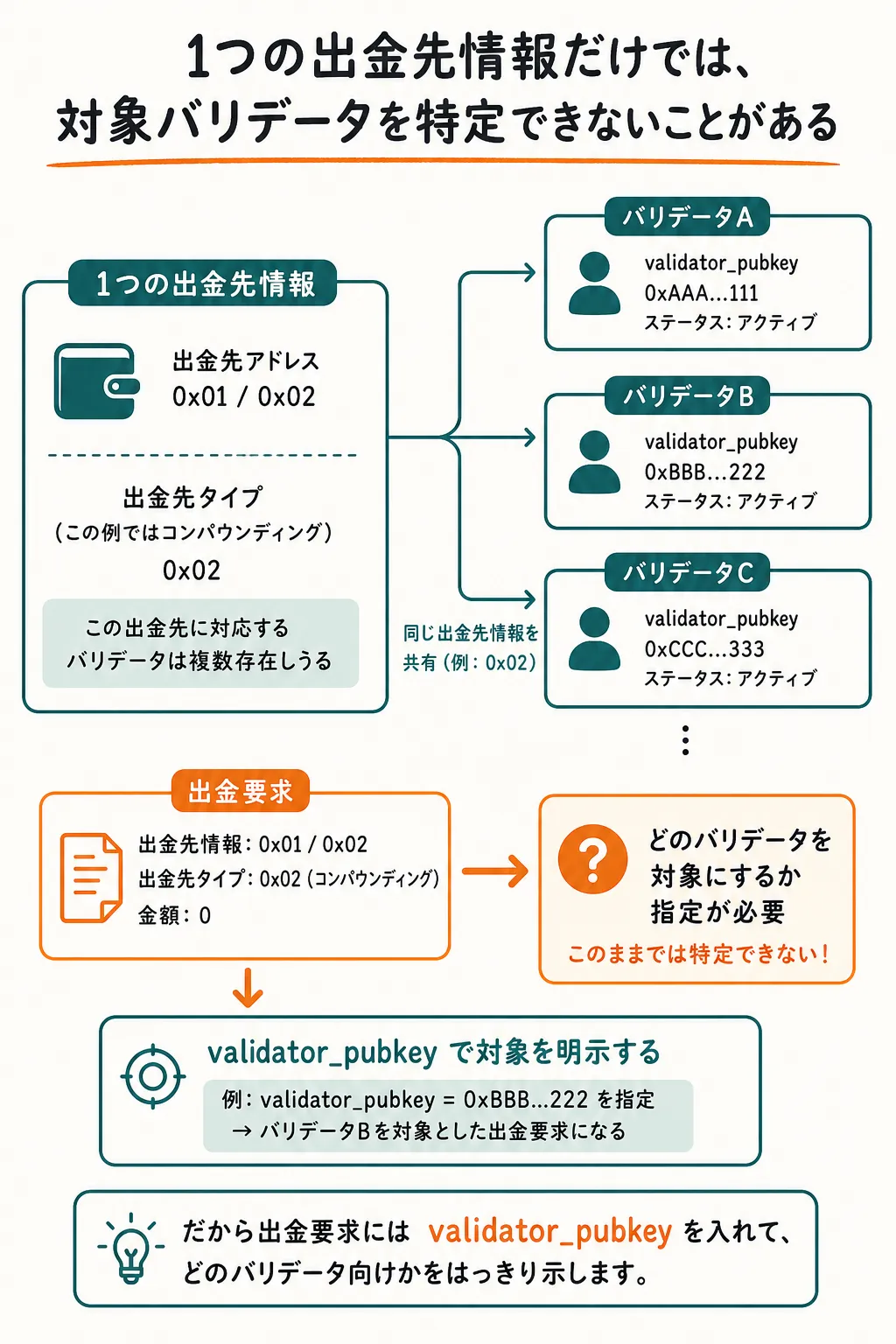
The diagram shows that multiple validators may share one withdrawal destination.
The fact that a request came from that destination is therefore insufficient; validator_pubkey must explicitly identify the validator concerned.
The handling of amount is particularly important for implementers.
The calldata supplied to the contract is validator_pubkey || big-endian uint64 amount, but the amount in requests assembled and returned from the queue is little-endian.
The CL also interprets the amount in Gwei.
Remember not only that the field is a uint64, but also that the input and output byte orders differ and that the unit is Gwei.
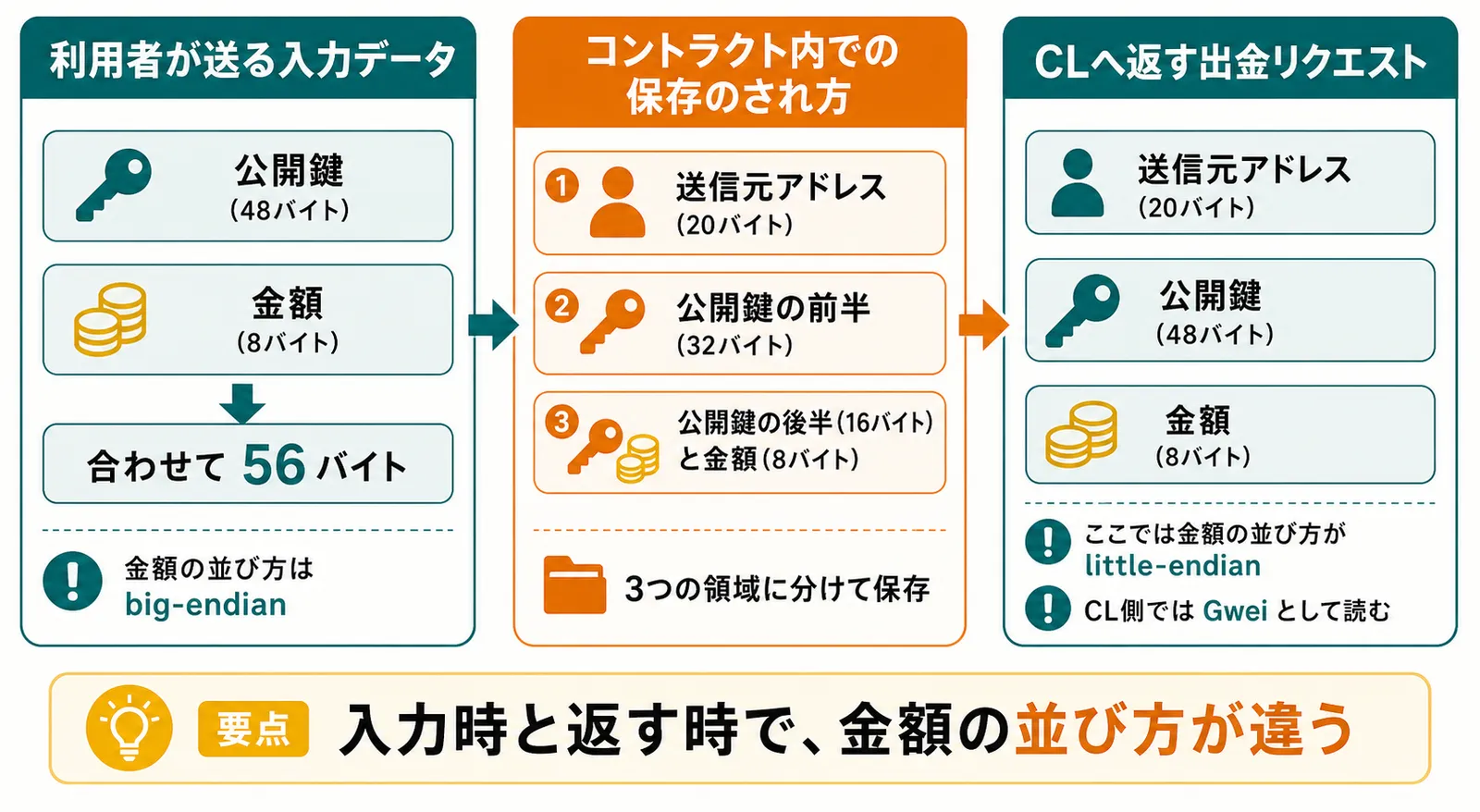
The diagram compares the user's 56-byte calldata, the three-slot queue layout, and the withdrawal request data returned by the contract. The crucial distinction is that the amount is big-endian on input but little-endian in the value assembled from the queue, which the CL interprets in Gwei.
Three Contract Code Paths
The withdrawal-request contract has three main entry paths.
| Code path | Input condition | Purpose |
|---|---|---|
| Add Withdrawal Request | 56 bytes of calldata | Add a request to the queue |
| Fee Getter | Zero-length calldata | Return the current required fee |
| System Process | Called by SYSTEM_ADDRESS |
Dequeue requests and update internal state |
The 56 bytes consist of the 48-byte validator public key followed by the eight-byte big-endian amount.
The source address is not included in calldata. It is obtained from the EVM's CALLER, corresponding to msg.sender.
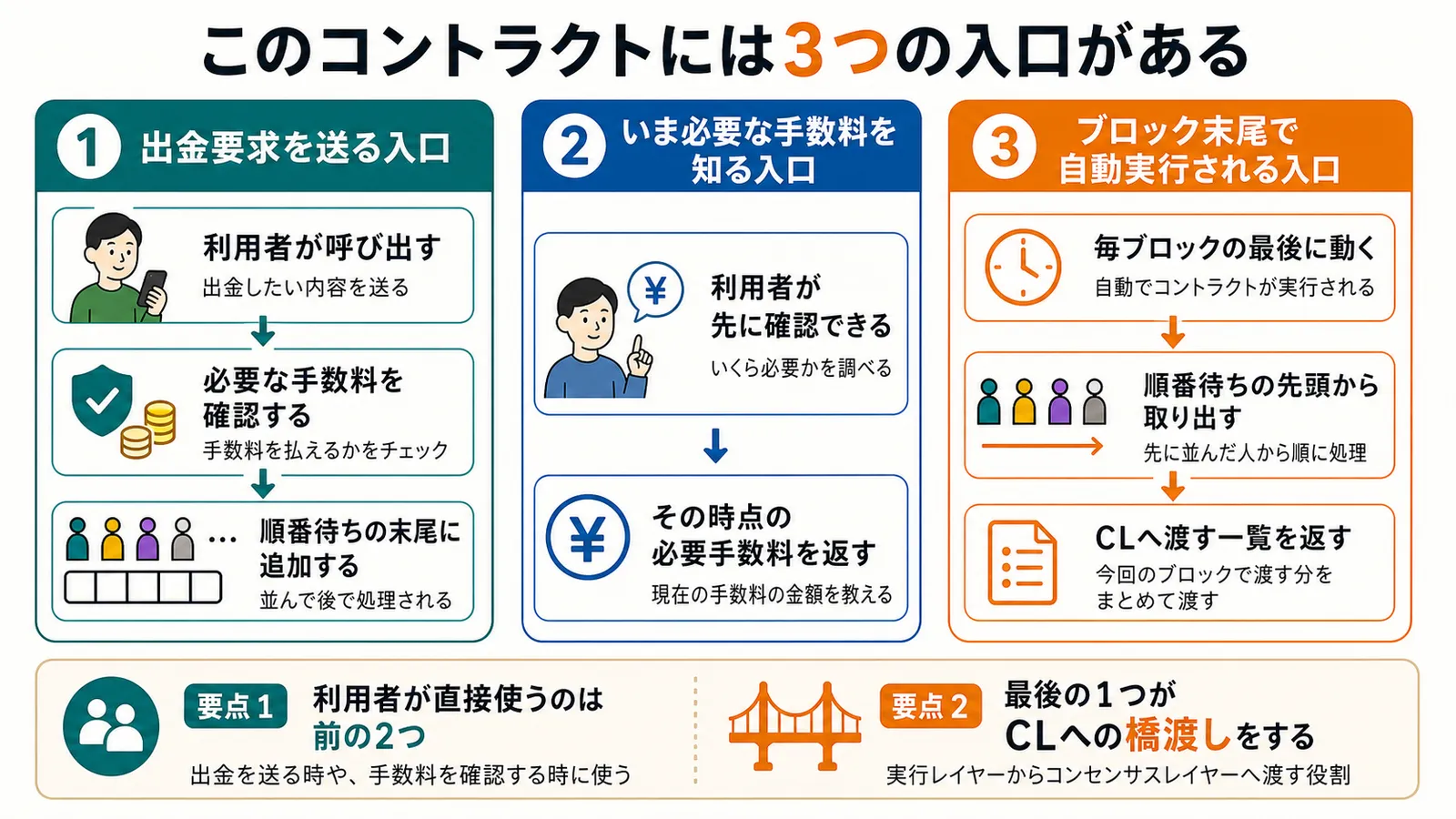
The diagram shows how the same withdrawal-request contract behaves differently for 56-byte calldata, empty calldata, and an end-of-block call from SYSTEM_ADDRESS.
Users normally interact with the request submission and fee lookup paths, but the third path is essential to the protocol: it dequeues requests and passes them to the CL.
Adding a Request
The Add Withdrawal Request path checks the fee before appending a request to the queue. The EIP gives the following pseudocode.
def add_withdrawal_request(Bytes48: validator_pubkey, uint64: amount):
    fee = get_fee()
    require(msg.value >= fee, 'Insufficient value for fee')

    count = sload(WITHDRAWAL_REQUEST_PREDEPLOY_ADDRESS, WITHDRAWAL_REQUEST_COUNT_STORAGE_SLOT)
    sstore(WITHDRAWAL_REQUEST_PREDEPLOY_ADDRESS, WITHDRAWAL_REQUEST_COUNT_STORAGE_SLOT, count + 1)

    queue_tail_index = sload(WITHDRAWAL_REQUEST_PREDEPLOY_ADDRESS, WITHDRAWAL_REQUEST_QUEUE_TAIL_STORAGE_SLOT)
    queue_storage_slot = WITHDRAWAL_REQUEST_QUEUE_STORAGE_OFFSET + queue_tail_index * 3
    sstore(WITHDRAWAL_REQUEST_PREDEPLOY_ADDRESS, queue_storage_slot, msg.sender)
    sstore(WITHDRAWAL_REQUEST_PREDEPLOY_ADDRESS, queue_storage_slot + 1, validator_pubkey[0:32])
    sstore(WITHDRAWAL_REQUEST_PREDEPLOY_ADDRESS, queue_storage_slot + 2, validator_pubkey[32:48] ++ uint64_to_little_endian(amount))
    sstore(WITHDRAWAL_REQUEST_PREDEPLOY_ADDRESS, WITHDRAWAL_REQUEST_QUEUE_TAIL_STORAGE_SLOT, queue_tail_index + 1)
Note the following details.
- Check the fee
The request is accepted only if
msg.valueis at least the currently required fee. - Update the per-block count
Accumulate the number of requests added during the block in
WITHDRAWAL_REQUEST_COUNT_STORAGE_SLOT. - Store the request
Store
msg.sender, the first 32 bytes of the public key, and the remaining 16 bytes of the public key together with the eight-byte amount, across three slots. - Update the tail Advance the queue tail pointer by one.
Under this design, the number of requests accepted during an execution block is not capped by the 16-request dequeue limit, although the block gas limit and other transaction constraints still apply. The later dequeue step caps the number passed to the CL, separating intake throughput from processing throughput.
Fee Lookup and Dynamic Fees
When called with empty calldata, the contract returns the current required fee. Users are expected to query the fee first and attach the required amount when submitting the request.
The fee calculation uses get_fee() and fake_exponential().
def get_fee() -> int:
    excess = sload(WITHDRAWAL_REQUEST_PREDEPLOY_ADDRESS, EXCESS_WITHDRAWAL_REQUESTS_STORAGE_SLOT)
    require(excess != EXCESS_INHIBITOR, 'Inhibitor still active')
    return fake_exponential(
        MIN_WITHDRAWAL_REQUEST_FEE,
        excess,
        WITHDRAWAL_REQUEST_FEE_UPDATE_FRACTION
    )
The approach is similar to EIP-1559: fees remain low when demand averages roughly two requests per block and rise exponentially as demand increases. This makes it more difficult for malicious users to keep filling the queue using only inexpensive gas.
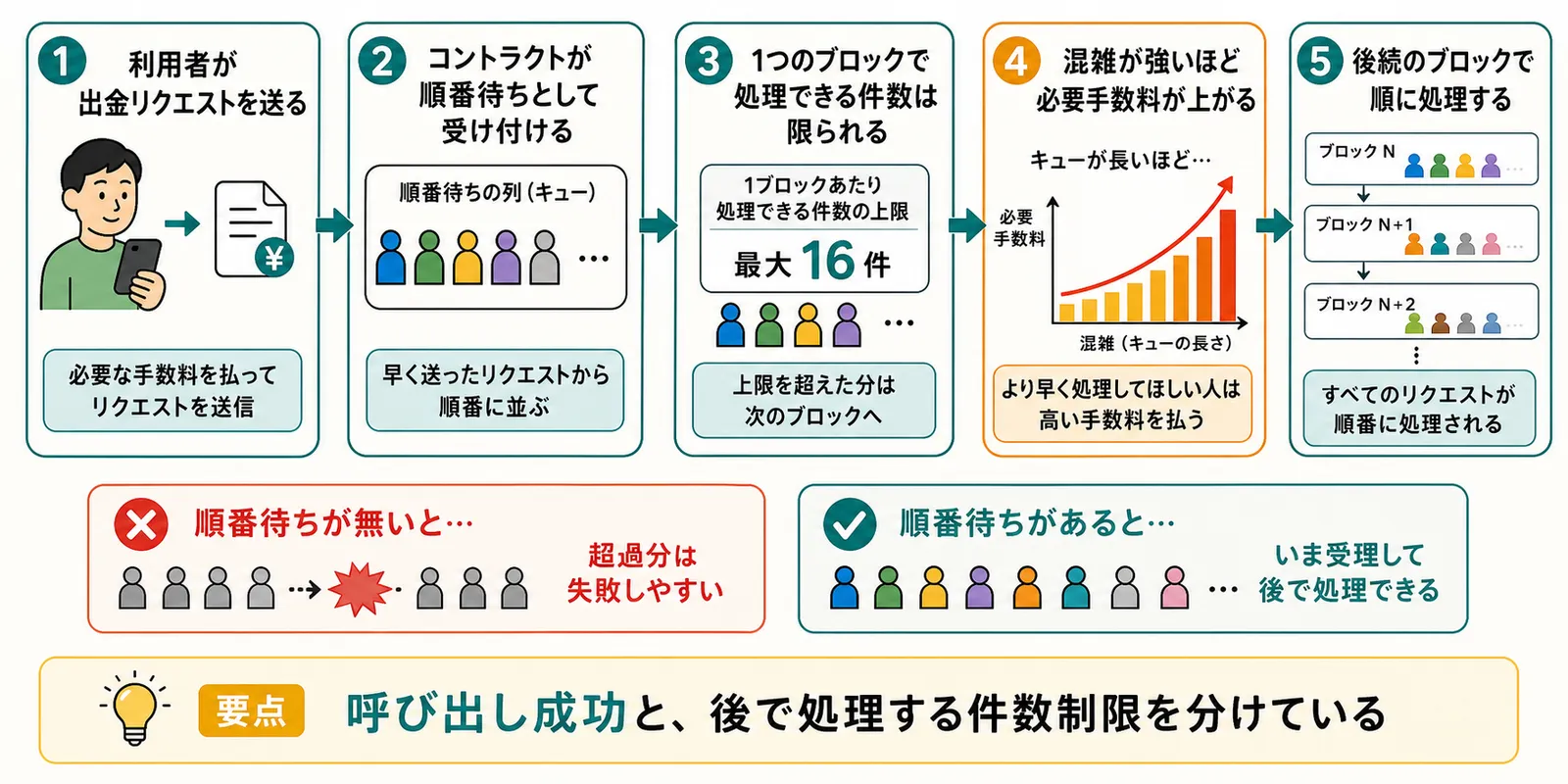
The diagram shows that user requests first enter a queue, with the per-block processing cap applied later. At the same time, higher demand raises the required fee. Instead of immediately rejecting requests above the processing cap, the design separates successful submission from subsequent processing while mitigating congestion and griefing.
For background on EIP-1559, see the following article.
[EIP-1559] Ethereum's Gas Pricing Mechanism
System Call and Dequeue Processing
At the end of every execution block, a system call with empty calldata is made from SYSTEM_ADDRESS to the withdrawal-request contract at its designated address.
The contract dequeues requests from the head of the queue, updates its internal state, and returns the requests to pass to the CL.
The EIP's core logic is as follows.
def read_withdrawal_requests():
    reqs = dequeue_withdrawal_requests()
    update_excess_withdrawal_requests()
    reset_withdrawal_requests_count()
    return ssz.serialize(reqs)
The system call is subject to several strict constraints.
| Item | Requirement |
|---|---|
| Gas limit | Dedicated limit of 30_000_000 |
| Gas accounting | Gas consumed by this call does not count toward total block gas usage |
| Fee burn | Not subject to the EIP-1559 fee burn |
| Missing code | The block is invalid |
| Call failure | The block is invalid |
This is a critical distinction. It is not merely an auxiliary call but a system operation directly affecting block validity after the fork. The chain must therefore be prepared for activation, and the withdrawal-request contract must operate correctly at the specified address.
Consensus-Layer Processing
For detailed CL processing, the EIP refers to the consensus specifications.
In Electra, block.body.execution_requests.withdrawals contains up to 16 WithdrawalRequest objects, each evaluated by process_withdrawal_request().
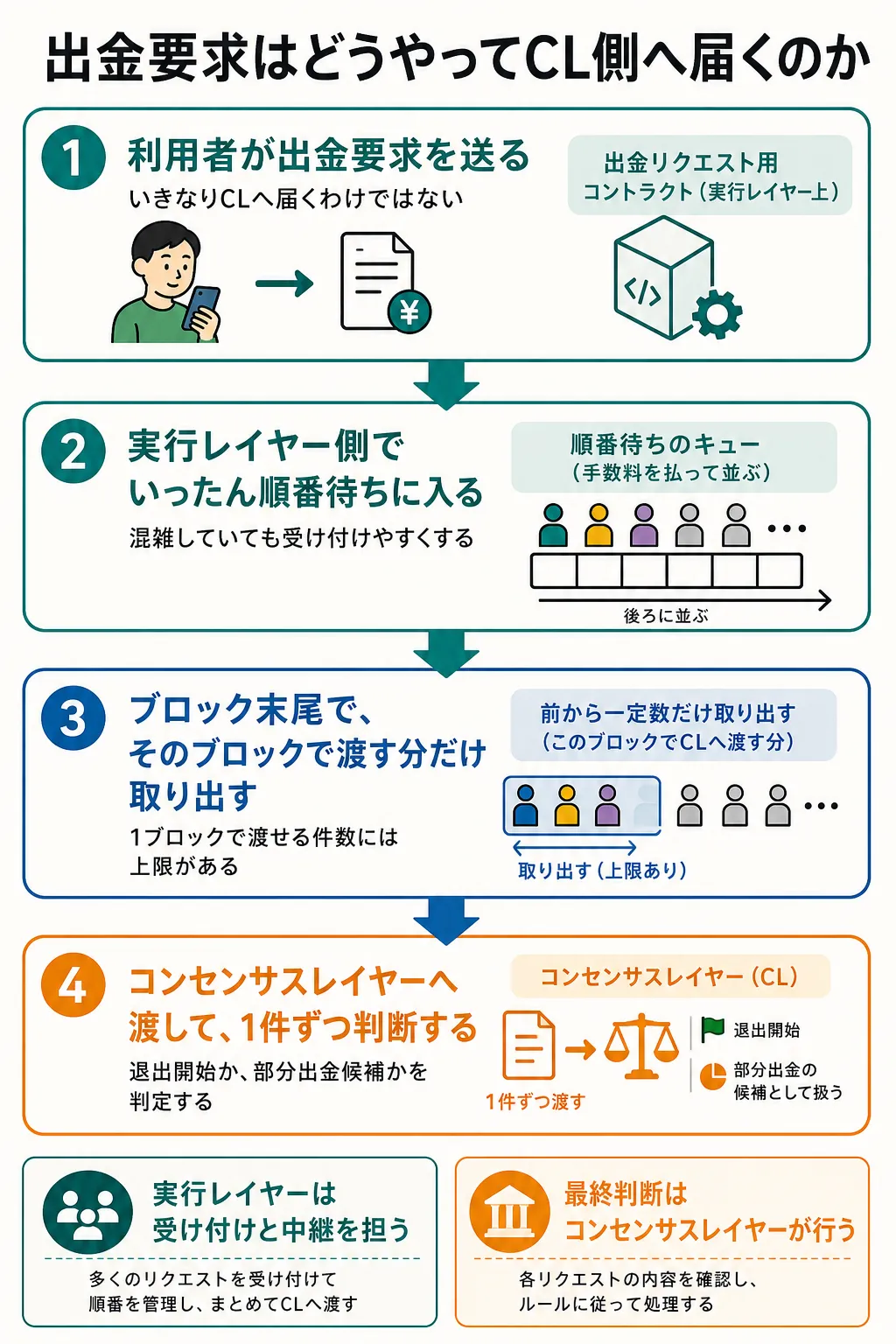
The diagram shows how the execution-layer queue and the list returned by the system call are represented as bytes consisting of 0x01 + SSZ list and carried to Electra's BeaconBlockBody.execution_requests.withdrawals.
EIP-7685 provides the rules for passing the requests, and Electra receives them in the withdrawals field of execution requests.
The important point is that the CL first checks whether the request came from valid execution-layer withdrawal credentials before branching into the full-exit or partial-withdrawal path.
Electra uses the predicate has_execution_withdrawal_credential(), so source-address authentication covers both 0x01 and 0x02 compounding credentials.
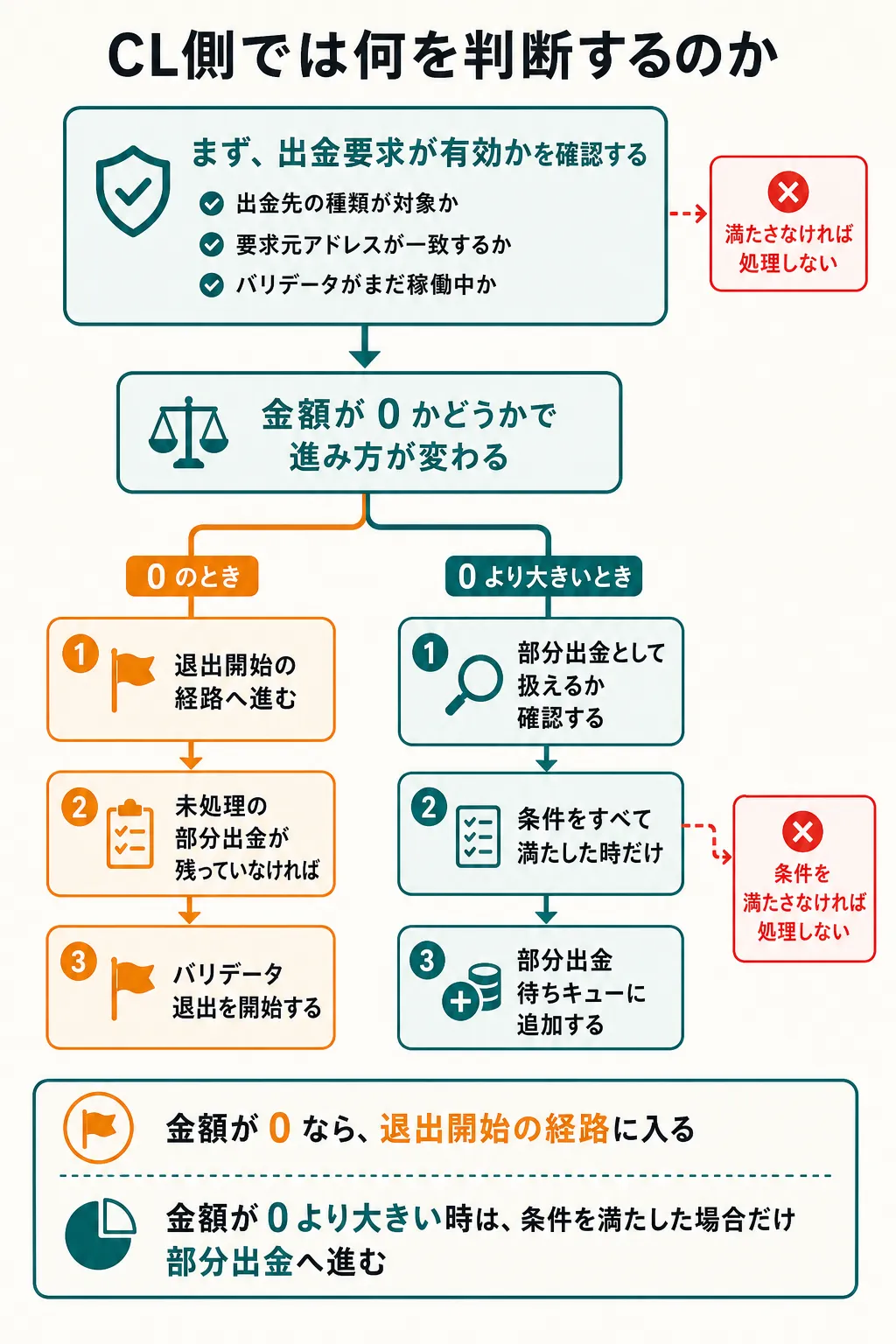
The diagram shows the CL first checking the withdrawal credential type and source address, then branching according to whether the amount is zero or positive.
amount == 0 signals a full exit, whereas amount > 0 only identifies a partial withdrawal candidate. It is added to pending partial withdrawals only if conditions such as a 0x02 compounding credential and excess balance are satisfied.
The branches can be summarized as follows.
amount == 0Interpreted asFULL_EXIT_REQUEST_AMOUNT. This signals a full exit. If no pending partial withdrawal remains for the validator and the other exit eligibility conditions are met, the CL initiates its exit.amount > 0Interpreted as a partial withdrawal candidate. It is actually added to pending partial withdrawals only if the validator has a0x02compounding credential, sufficient effective balance, excess balance, and meets the other requirements.- Requests that fail the checks An individual request is ignored if, for example, the public key does not exist, the source address does not match, the validator is already exiting, or the applicable partial withdrawal queue is full.
Submitting a positive amount therefore does not automatically cause a partial withdrawal. The EL passes the request along; the CL decides whether to initiate a full exit, add a pending partial withdrawal, or do nothing.
Rationale
Why Use validator_pubkey?
A validator index might appear to be sufficient, but smart contracts such as staking pools do not know the validator's index before it is created. The public key is known in advance, making it easier to construct a request from the EL.
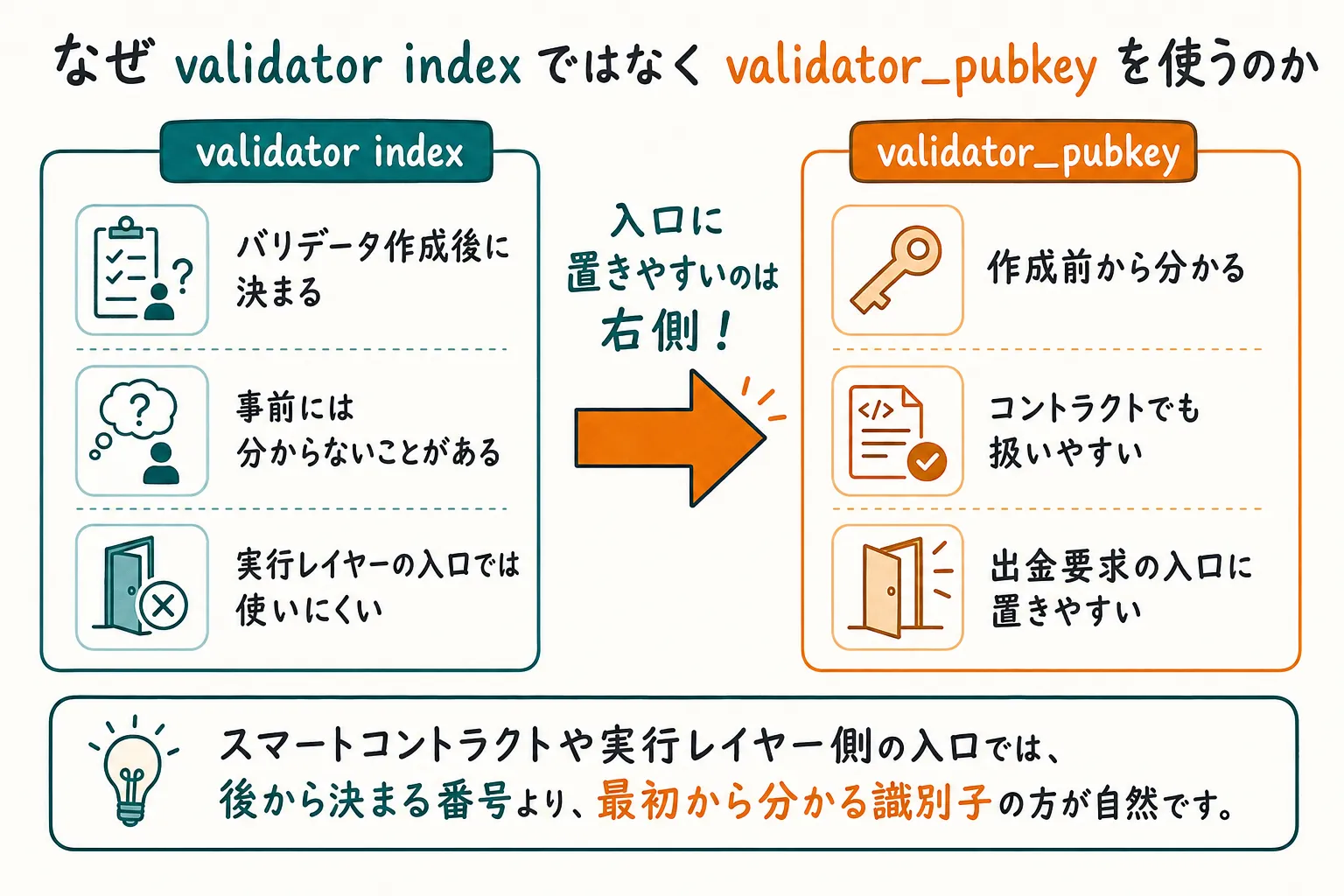
The diagram contrasts the validator index, a number assigned later, with the validator public key, an identifier known in advance. A public key is therefore a more natural input than an index for requests constructed on the execution layer.
The specification avoids limiting the feature to parties with detailed CL knowledge and instead uses an input that smart contracts can readily handle.
Why Maintain a Queue?
An alternative design would reject contract calls once the number of requests within a block exceeds MAX_WITHDRAWAL_REQUESTS_PER_BLOCK.
However, this would also make honest users' transactions more likely to fail during congestion.
A queue allows users' calls to succeed while rate-limiting only the transfer of requests to the CL. The EIP favors this user experience and therefore adopts the queue-based approach.
Mitigating Griefing with Fees
One attack the proposal aims to mitigate is flooding the system with cheap withdrawal requests to delay other users' exits. Strict per-validator request limits with proofs of CL state are another possibility, but they would require additional cross-layer assumptions such as EIP-4788 and additional state tracking.
EIP-7002 avoids this complexity and instead uses an economic mechanism: increasing the fee when demand is high. Keeping fees low under normal conditions and raising them during congestion aims to discourage abuse without increasing implementation complexity.
Relationship to EIP-7251
EIP-7002 is important in its own right, and its relationship to subsequent specifications provides further context. In particular, EIP-7251 increases the maximum effective balance of validators, making partial withdrawal and consolidation mechanisms important.
Partial withdrawals under EIP-7251 are triggered by execution-layer messages defined by EIP-7002. EIP-7002 is thus one of the foundations of the staking improvements introduced with Electra.
For background on EIP-7251, see the following article.
[EIP-7251] Increasing the Maximum Effective Balance to 2048 ETH
Compatibility
EIP-7002 changes block structure and block validation rules, so it is not backward-compatible. After the fork, both execution and consensus clients must understand the new request processing to validate blocks correctly.
However, the change does not break ordinary ETH transfers or smart contract usage by existing users. Its main impact is on the protocol rules governing validator exits and partial withdrawals.
Security Considerations
Impact on Existing Custody Arrangements
The change allows the party controlling withdrawal credentials to initiate an exit request. If an existing custody arrangement depends on the assumption that withdrawal credentials cannot initiate exits, its expected division of responsibilities may change.
The EIP reasons that because the withdrawal-credential holder is ultimately associated with ownership of the assets, granting that party exit authority is appropriate.
To preserve the old behavior, one option is to direct 0x01 withdrawal credentials to a smart contract that enforces equivalent restrictions.
Overpaying the Fee
The contract does not refund excess request fees. The fee may also change between transaction construction and inclusion. Request submitters should therefore check the current required fee first and, where contract logic permits, revert if it exceeds the expected limit.
When sending a request directly from an EOA, paying the exact amount can be difficult, making overpayment more likely. This consideration is separate from ordinary transaction gas fees.
Handling System Call Failure
After the fork, a failed system call to the withdrawal-request contract makes the block invalid. If problematic transactions remain in the mempool, the same failure may recur in the next slot.
The EIP recommends that block producer implementations consider approaches such as shuffling the transaction set to construct a valid block that excludes problematic transactions. Discarding an invalid block alone is not sufficient; retry behavior involving the mempool must also be considered.
Failure When Contract Code Is Missing
Activating the EIP without code at WITHDRAWAL_REQUEST_PREDEPLOY_ADDRESS makes blocks invalid starting with the first affected block, unless the required code is installed in time for the system call.
The specification treats the presence of the contract at that address as a protocol prerequisite.
The EIP outlines two recovery approaches.
- Install the contract code first Install the code through a transaction so that the block containing the deployment can become the first valid block.
- Postpone activation Move the client implementation's fork timestamp or block number later, allowing the contract to be prepared before activation.
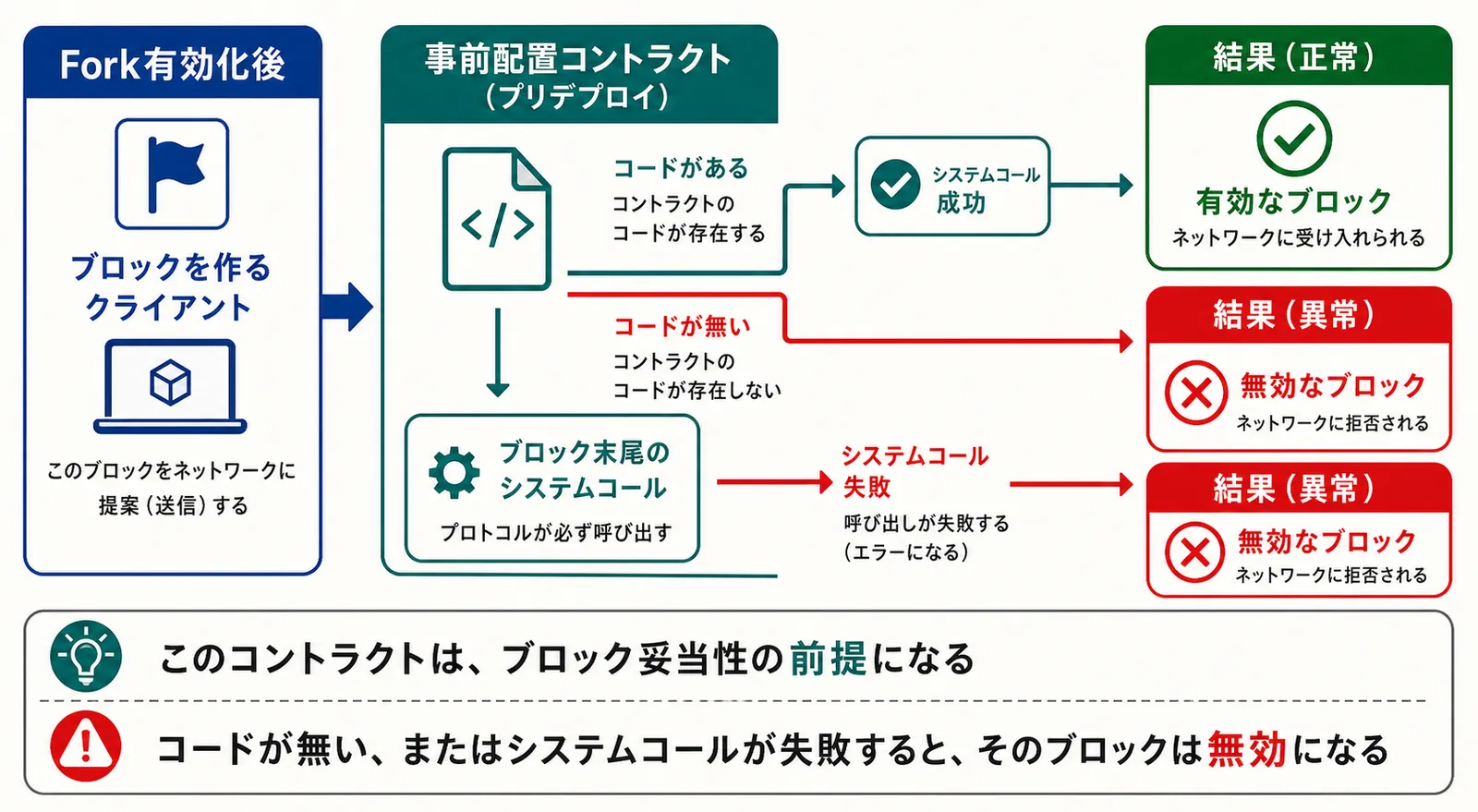
The diagram shows how missing contract code or a failed system call after fork activation causes a block to be invalid rather than accepted as valid. The contract is therefore not simply an auxiliary contract; it is a prerequisite for block validity after the fork.
Conclusion
This article examined EIP-7002.
By giving withdrawal-credential holders the ability to initiate exits and partial withdrawal requests, EIP-7002 allows the ultimate owner of staked assets to exercise more direct control. The design encompasses the execution-layer withdrawal-request contract, queue, dynamic fee, and transport to the CL through EIP-7685. It also provides a foundation for specifications such as EIP-7251.
See the original specification for further details.
I also publish articles on the following platforms.




